# Pulse — a festival site whose landscape moves like a sound spectrum
> Paste this whole prompt as one message into a new, empty project.
## 1. Role and goal
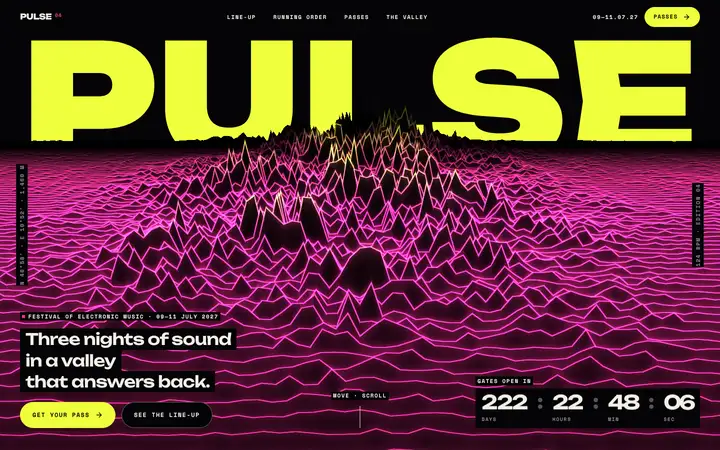
You are a senior creative developer and art director. Build the one-page site of **Pulse**, a three-night festival of electronic music in an alpine valley (edition 04, 9 to 11 July 2027): a rave flyer that came alive, in black, neon magenta and acid yellow, with one wide display face.
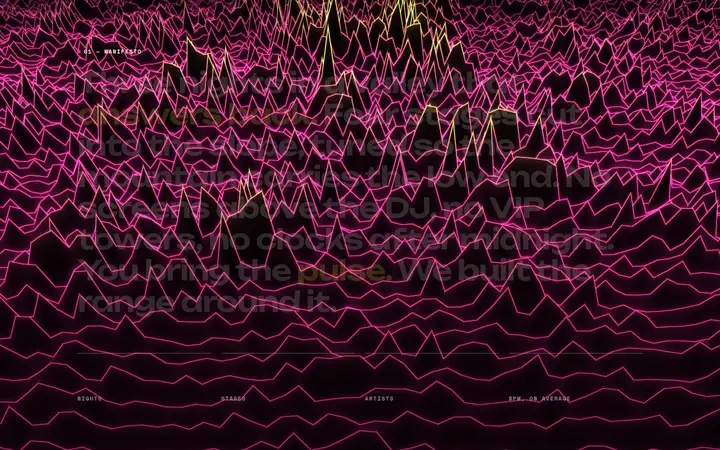
The site has one signature object, drawn in real time with WebGL: **a landscape of glowing ridgelines**, the stacked-line plot of a sound spectrum. It is the centre of the first screen, the pointer raises a wave in it, and the scroll transforms it: the camera rises over the range, flies over it, looks straight down on it under the line-up, returns to a low sea under the pass, and at the end the field goes flat except for one heartbeat. The brand word of the first screen is real text placed *behind* the canvas, so the mountains hide its foot.
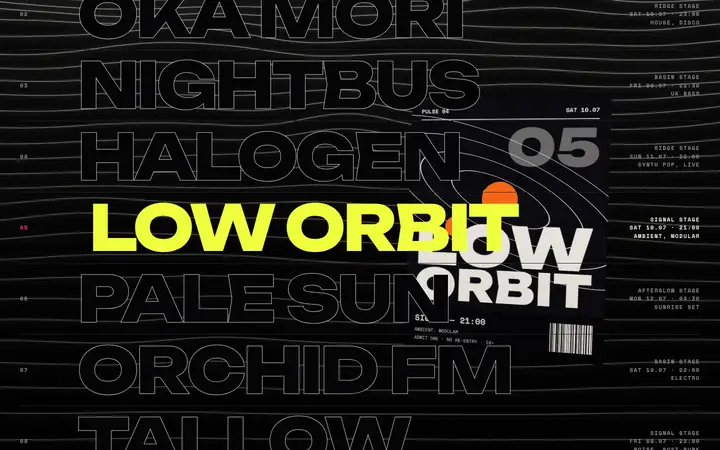
Three more things live in the same canvas and answer the visitor: a **poster** generated by a shader for each artist, a **pass** with holographic foil that tilts, spins and can be dragged, and the colours and waveform of the terrain, which follow the active artist.
Deliver a finished site: navigation, seven sections, footer, the copy of section 9, responsive from 360 px, with the fallbacks of section 8. Where this document is silent, decide like a designer who has read it.
## 2. Stack and constraints
- **Next.js (App Router) with TypeScript and Tailwind CSS v4** (`@import "tailwindcss";`, tokens in `@theme`). One route, one page.
- **three** with **@react-three/fiber** and **@react-three/drei** (drei is optional: nothing in this scene needs it). **gsap** with **ScrollTrigger** and **SplitText**. **lenis** for smooth scrolling. **lucide-react** for four icons.
- **Fonts**: Unbounded (variable; weights 600, 700, 800, 900) and Space Mono (400, 700), Latin subset, loaded with `next/font` (or self-hosted packages in a Vite project). The 2D canvas drawings use the same families: draw, then draw again once `document.fonts.load()` has resolved for both. With `next/font` the family name is generated: read it from the CSS variable.
- The scene is a **client component loaded without server rendering** (`next/dynamic`, `ssr: false`). Everything that reads `window` runs in effects.
- **No external assets: every visual is generated in code.** No image, video, 3D model or HDR file, no icon font, no remote font or script. Forbidden because they download files: drei `Environment` with `preset` or `files`, `useGLTF`, `useTexture` with an address, drei `Text` without a local font file, any `<link>` or CSS import pointing to a font or script host. Textures come from shaders or from 2D canvases drawn at run time.
- **One WebGL canvas for the whole page**, fixed behind the content.
- **Never leave the page**: every link is an in-page anchor or a button. No new tab, no `alert`. The newsletter form answers in place.
- **One clock.** A single `gsap.ticker` callback runs, in order: `lenis.raf(time * 1000)`, the per-frame work of the sections (reading rectangles, toggling states), then `advance(time)` from @react-three/fiber, whose `<Canvas>` has `frameloop="never"`. Every change of state that comes from time or from the scroll (theme, navigation, active name, reveals, counters) is made in this loop or by gsap. CSS transitions are kept for hover states only; no CSS keyframes.
- DOM animation uses `transform` and `opacity` only. No `filter: blur()`, no `backdrop-filter`.
## 3. Design tokens
**Colours** (in `@theme`, plus `--accent` on `:root`):
- `bg` `#050406`: page background.
- `panel` `#0D0B10`: the one opaque dark section (the valley).
- `line` `#26222C`: hairlines on dark.
- `fg` `#F3EFE6`: main text, bone white.
- `muted` `#8D8794`: secondary text.
- `accent` `#FF2D95`: neon magenta; ridgelines, markers, edge of the pass, playhead.
- `volt` `#F0FF3C`: acid yellow; brand word, buttons, active states, the yellow section.
- `volt-ink` `#0A0A05`: text and rules on yellow.
- `hot` `#FFFCD8`: scene only, lines under the pointer.
- Guests `#2D4BFF`, `#FF6A1A`, `#8A3DFF` (blue, orange, violet): posters and the terrain of some artists.
Yellow is never used for long text on black; magenta never for text smaller than a label.
**Type**: display **Unbounded**, uppercase; everything else **Space Mono**. Size; line height; tracking:
- Brand word, Unbounded 900: fitted to its line (5.3); 1; -0.045em.
- Line-up names, Unbounded 800: one fitted size (5.5); 1.02; -0.045em.
- Section title, Unbounded 800: `clamp(2rem, 0.9rem + 4.6vw, 5.25rem)`; 0.94; -0.04em.
- Statement, Unbounded 600: `clamp(1.5rem, 0.7rem + 3.1vw, 3.75rem)`; 1.12; -0.035em.
- Claim, Unbounded 600: `clamp(1.125rem, 0.75rem + 1.5vw, 2rem)`; 1.32; -0.03em.
- Figures, Unbounded 800: `clamp(2rem, 1.2rem + 3vw, 4rem)`; 1; -0.05em.
- Countdown, Unbounded 800: large `clamp(2rem, 8.2vw, 8.75rem)`, small (700) `clamp(1.5rem, 1rem + 1.6vw, 2.5rem)`; 1; -0.04em.
- Sub (tiers, prices), Unbounded 700: `clamp(1.125rem, 0.9rem + 0.9vw, 1.75rem)`; 1.1; -0.035em.
- Body, Space Mono 400: `clamp(0.8125rem, 0.77rem + 0.22vw, 0.9375rem)`; 1.6; 0.
- Label, Space Mono 700 uppercase: `0.6875rem`; 1.3; 0.14em.
- Micro, Space Mono 400 uppercase: `0.625rem`; 1.4; 0.12em.
- Button, Space Mono 700 uppercase: `0.75rem`; 1; 0.12em.
**Spacing**: side padding `--pad: clamp(16px, 2.8vw, 40px)`; column gap `--gap: clamp(12px, 1.4vw, 24px)`; section padding `--section: clamp(72px, 10vw, 152px)`; inner rhythm in steps of 4 px.
**Radii**: `999px` for buttons; `0` everywhere else. Hairlines: 1 px `line` on dark, 1.5 px `volt-ink` on yellow.
**Easing vocabulary** (only these):
- `snap` = `cubic-bezier(0.16, 1, 0.3, 1)`, gsap `expo.out`: entrances, hovers, navigation, digits; 0.5 to 0.9 s.
- `glide` = `cubic-bezier(0.76, 0, 0.24, 1)`, gsap `power3.inOut` or `power2.inOut`: spin of the pass, wipe bars, phone menu; 0.6 to 1.2 s.
- `kick` = `cubic-bezier(0.34, 1.56, 0.64, 1)`, gsap `back.out`: things that land (the range springing up, map points, the radio dot).
- `elastic.out(1, 0.55)`: only the pass settling after a drag. Scrubbed animations are linear.
**Recurring devices**
- *Strip*: text lying over the scene gets a `bg` background on each of its lines (`box-decoration-break: clone`, padding `0.12em 0.34em`).
- *Tag*: a label preceded by a 0.55em square in `accent`.
- *Button*: pill 3.25rem high, padding 0 1.5rem, `volt` fill, `volt-ink` text, arrow icon 1rem. Hover: a `fg` fill rises from the foot (pseudo-element, `translateY(101%)` to 0, 0.5 s `snap`), the arrow moves 0.35rem; active: scale 0.97. Ghost variant: `bg` fill, `fg` text, border `fg` at 40%. Small variant: 2.5rem high.
- *Link*: a 1 px rule redrawn from the left on hover (`scaleX`, origin switching from right to left, 0.5 s `snap`).
## 4. Layout
- 12 columns, `minmax(0, 1fr)`, gap `--gap`, side padding `--pad`, no maximum width. Asymmetry is deliberate: titles hang on the left edge, secondary text sits in columns 9 to 12, the manifesto is indented by one column.
- **Stacking**: `bg` on `html`; the brand word at `z-index: 0`; the canvas `position: fixed; inset: 0; z-index: 1; pointer-events: none`; every content block `position: relative; z-index: 2`; navigation `z-index: 40`. The first screen itself must not create a stacking context (no transform, opacity or z-index on the section), or the word cannot sit behind the canvas.
- **Heights on desktop** (about 9.1 screens at 1440 x 900): first screen `100svh` (min 560 px); manifesto `150vh` with a sticky inner of `100vh`; line-up, natural (about 1.4 screens); running order `182vh` with `margin-top: -40vh` and a sticky inner of `100vh`; passes `135vh` with a sticky inner of `100vh`; the valley, natural (about 0.9 screen), opaque; closing `88vh` (min 560 px); footer.
- Pins use `position: sticky`, never pin spacers. `html` and `body` use `overflow-x: clip` (`hidden` would break sticky).
- `<html data-theme="dark">`; the value becomes `"volt"` while the yellow section covers the top 34 px of the viewport.
## 5. Sections
### 5.1 The scene
**Canvas.** `<Canvas frameloop="never" dpr={[1, 1.75]} gl={{ alpha: true, antialias: false, powerPreference: "high-performance" }} camera={{ fov: 40, near: 0.1, far: 140 }}>`, transparent clear colour. Only `ShaderMaterial` is used and colours are written as they are: build them with `new THREE.Color().setStyle(hex, THREE.LinearSRGBColorSpace)`, leave canvas textures without a colour space, no tone mapping. Edges are anti-aliased in the shaders, hence no multisampling. Vertical field of view 40 degrees, 48 when the aspect ratio is under 1.15, 58 under 0.7.
A plain mutable object, `store`, is shared by the page and the scene: viewport size, `scrollY`, `pointer` (viewport fractions, `seen` once a mouse or pen has moved; touch does not count), `intro` (`reveal`, `amp`, `cam`), `artist`, `lineup` (0 or 1), `posterY`, `tier`, `spin`, `drag`, `ticket` (progress of the pass section), `slot` (a DOM element) and `slotOn`, `reduced`, `accent`, and a `dirty` counter.
**The ridgelines**: one mesh, two draw calls, 92,160 triangles.
- 96 lines 0.45 apart, each 56 wide in 240 segments, each with three rows of vertices: the foot of a *curtain* 4.5 below, the line, the top of a *halo* 0.9 above. `position` stores `(x, level 0|1|2, row)`; the vertex shader computes the height. Indices run from near rows to far ones.
- Curtains (group 0): opaque, depth write on, black, alpha 1. Each hides the lines behind it, the hidden-line look of a stacked plot, and the DOM word behind the canvas. Halos (group 1): additive, depth write off, alpha 0, so the glow also adds over the page.
- Rows follow the camera in steps of one spacing and heights are sampled in world space: the terrain is endless and never pops.
- Height: four simplex samples (slow hills, a smooth swell, a ridged band, a spiky band) drifting away from the viewer. `uWave = (frequency, sharpness, drift)`: at sharpness 0 only smooth swells remain, from 0.3 the ridged bands are fully in. Then an envelope across x (one range in the middle, opening to the whole field with `uSpread`), a depth envelope (flat near the viewer), `uAmp`, and a +30% surge leaving the viewer every 2 s.
- Pointer: cast on the plane y = 0.8 (at most 34 units ahead), followed at a rate of 9 per second, a second point following the first at 2.2 per second. A mound of spikes 2.5 high, a ring leaving it, a wake 0.9 high; the lines there turn `hot`.
- `uFlat = 1`: the height becomes a heartbeat 2.3 high, repeated every 26 units, crossing the field at 8 units per second.
- Lines are 1.6 px wide at pixel ratio 1, go from `accent` to `volt` with height, fade between 38% and 100% of `uFar`; the nearest are dimmed to 60%.
**The camera story.** Thirteen keyframes sit at the scroll positions of the sections, measured from the DOM after every layout change (resize, fonts, ScrollTrigger refresh). Each holds camera height `y`, travel `z`, `pitch` (radians below the horizon) and, for the terrain, `amp`, `spread`, `dim`, `flat`, `sharp`, `ptr`, `far`. Values are eased with a smoothstep between two keys; the travel stays linear. In order: the range seen from a hill; rising over it as the first screen leaves; a fly-over ending almost in plan view under the manifesto (brightness 34%); the plot under the names (30%); nothing under the yellow section; a calm sea of smooth lines at the foot of the screen under the pass; nothing under the valley panel; the flat field and its heartbeat. Portrait screens start with a steeper pitch (0.36, not 0.25) so the range sits higher. The pointer leans the camera by up to 0.45 units.
The rig publishes two CSS variables on the root, fractions of the viewport height obtained by projecting two points of the resting first screen: `--crest` (a peak 3.6 high, 22 ahead) and `--skyline` (the flat far edge, 44 ahead). The first screen places the brand word with them (5.3).
**The poster** (line-up): a plane 1.5 x 2 in camera space, 6 units ahead, no depth test, drawn after the ridges. From 900 px it is `min(64vh, 36vw)` high, centred at 70% of the width; below, `min(44vh, 84vw)` and 62%. Its vertical centre follows `store.posterY` (rate 5 per second); rotation `(py * 0.16, -0.24 + px * 0.3, -0.035 + lag * 0.5)`, `px, py` being the pointer from the centre. It is printed from its foot up: `uShow` follows `store.lineup` at 7 per second, with the unclamped frame time so the sheet is gone at once after a pause. One shader holds the eight patterns of 5.5 and reads the type from a 2D-canvas atlas. A new poster arrives in 18 horizontal bands with their own delays, in 0.3 s; a change asked during a wipe waits for its end.
**The pass** (passes): two planes 3.328 x 1.456 (the card is 3.2 x 1.4), 0.04 apart, in camera space 6 units ahead, kept on an empty DOM element, the *slot*: each frame its rectangle gives the centre and the width, `min(0.94 * slot width, 0.86 * slot height * 3.2 / 1.4)`. The shader cuts the outline with a signed distance: a rounded rectangle (radius 0.09) minus two half-round bites (radius 0.075) on the tear line, at 75% of the width. Each sheet shows its print on one side and the painted edge (accent) on the other; no depth test, the sheet further from the eye is drawn first, which leaves a thin coloured edge at an angle. Light is a studio in three terms of the reflection vector: a soft box up left, a strip light that sweeps across as the card turns, a rim. Where the foil mask is white the paper becomes a hologram: a rainbow whose phase follows the reflection across a diagonal grating, in 96 x 42 sparkling cells. Behind the card, an additive radial glow in the accent colour (plane 7.5 x 5, 0.6 behind, peak 0.22).
Rotation of the card (x, y, z): `(-0.16 + py * 0.55 + cos(t * 0.5) * 0.05 + (1 - enter) * 0.5, 0.2 - pin * 0.7 + px * 0.8 + sin(t * 0.6) * 0.08 - (1 - enter) * 2.6 + spin + drag, -0.07 + (1 - enter) * 0.35)`: `px, py` the pointer from the centre (eased at 6 per second), `enter` the `outCubic` of the section coming in (its top travelling from the bottom to the top of the viewport), `pin` the progress of the pinned part.
**Quality and rest.** Pixel ratio capped at 1.75; at most 5 draw calls and about 92,000 triangles; terrain noise in the vertex shader only (one simplex call in one poster is the only fragment noise); no post-processing. Nothing is drawn while the tab is hidden, nor while the scene has nothing to show (brightness 0, no poster, slot of the pass off screen: under the yellow section and the valley panel); one last frame clears the canvas.
#### Reference code
Use this code as written; adapt only imports and file layout to the project. It holds the terrain (geometry, shaders, pointer and scroll mapping), the keyframes and the camera rig, and the shaders of the pass and of the posters. `store` is the object above; `ARTISTS` and `COLORS` are the data of sections 3, 5.5 and 9.
```tsx
// scene/Ridges.tsx: the terrain (imports: three as THREE, useMemo, useFrame and useThree, store, sampleStory, restPose, ARTISTS, COLORS)
export const ROWS = 96; // ridgelines, near to far
export const COLS = 240; // segments per line
export const WIDTH = 56; // world units across
export const SPACING = 0.45; // distance between two lines
const HALO = 0.9; // height of the glow strip above a line
const DROP = 4.5; // depth of the black curtain under a line
/** Colours are written to the frame buffer as they are (no tone mapping, no colour-space pass). */
export const raw = (hex: string) => new THREE.Color().setStyle(hex, THREE.LinearSRGBColorSpace);
export const SNOISE = /* glsl */ `
vec3 permute(vec3 x) { return mod(((x * 34.0) + 1.0) * x, 289.0); }
float snoise(vec2 v) {
const vec4 C = vec4(0.211324865405187, 0.366025403784439, -0.577350269189626, 0.024390243902439);
vec2 i = floor(v + dot(v, C.yy));
vec2 x0 = v - i + dot(i, C.xx);
vec2 i1 = (x0.x > x0.y) ? vec2(1.0, 0.0) : vec2(0.0, 1.0);
vec4 x12 = x0.xyxy + C.xxzz;
x12.xy -= i1;
i = mod(i, 289.0);
vec3 p = permute(permute(i.y + vec3(0.0, i1.y, 1.0)) + i.x + vec3(0.0, i1.x, 1.0));
vec3 m = max(0.5 - vec3(dot(x0, x0), dot(x12.xy, x12.xy), dot(x12.zw, x12.zw)), 0.0);
m = m * m; m = m * m;
vec3 x = 2.0 * fract(p * C.www) - 1.0;
vec3 h = abs(x) - 0.5;
vec3 ox = floor(x + 0.5);
vec3 a0 = x - ox;
m *= 1.79284291400159 - 0.85373472095314 * (a0 * a0 + h * h);
vec3 g;
g.x = a0.x * x0.x + h.x * x0.y;
g.yz = a0.yz * x12.xz + h.yz * x12.yw;
return 130.0 * dot(m, g);
}`;
const vertex = /* glsl */ `
uniform float uTime, uOriginZ, uAmp, uSpread, uFlat, uReveal, uFar;
uniform vec3 uCam; // camera position (world)
uniform vec3 uPtr; // pointer on the ground: world x, world z, strength 0..1
uniform vec2 uTrail; // slow follower of the pointer: world x, world z
uniform vec3 uWave; // frequency, sharpness 0..1, drift speed
varying float vD, vH, vHeat, vFade;
${SNOISE}
// the "spectrum": slow hills, a ridged mid band, a spiky top band, all drifting away from the viewer.
// uWave.y fades the two ridged bands in: at 0 only smooth swells remain.
float terrain(vec2 p, float t) {
float f = uWave.x;
float hills = snoise(vec2(p.x * 0.20 * f, p.y * 0.15 + t * 0.10)) * 0.5 + 0.5;
float swell = 0.5 + 0.5 * snoise(vec2(p.x * 0.34 * f + 11.0, p.y * 0.30 + t * uWave.z));
float mid = 1.0 - abs(snoise(vec2(p.x * 0.72 * f + 7.0, p.y * 0.40 + t * uWave.z)));
mid = pow(mid, mix(1.4, 3.4, uWave.y));
float top = max(snoise(vec2(p.x * 2.5 * f - 3.0, p.y * 1.25 + t * uWave.z * 2.2)), 0.0);
float spiky = hills * (0.30 + 1.25 * mid) + top * top * mix(0.25, 0.9, uWave.y);
return mix(hills * (0.35 + 0.9 * swell), spiky, smoothstep(0.0, 0.3, uWave.y));
}
// one heartbeat: a tall spike with a dip on each side and a late bump
float beat(float u) {
return 2.3 * exp(-u * u * 3.2) - 0.75 * exp(-(u - 0.95) * (u - 0.95) * 5.0)
- 0.4 * exp(-(u + 0.85) * (u + 0.85) * 6.0) + 0.38 * exp(-(u - 3.1) * (u - 3.1) * 0.9);
}
void main() {
float x = position.x, level = position.y, row = position.z;
float z = uOriginZ - row * ${SPACING.toFixed(2)};
float dz = uCam.z - z; // distance ahead of the camera
// where the range stands: a wandering centre in the first screen, the whole field in the fly-over
float cx = 1.8 * snoise(vec2(z * 0.05, 4.0));
float env = mix(0.04 + 0.96 * exp(-pow(abs(x - cx) / 6.4, 2.4)), 1.0, uSpread);
float depth = smoothstep(mix(5.0, 0.0, uSpread), mix(22.0, 5.0, uSpread), dz);
// a swell that leaves the viewer every two seconds and runs to the horizon
float ph = fract(uTime * 0.5 - dz * 0.022);
float surge = pow(1.0 - ph, 4.0) * smoothstep(0.0, 0.06, ph);
float h = terrain(vec2(x, z), uTime) * env * depth * uAmp * 1.75 * (1.0 + 0.3 * surge);
// the closing state: every line goes flat except for a heartbeat that crosses the field
float pulse = beat(mod(x - uTime * 8.0 + dz * 0.14 + 13.0, 26.0) - 13.0);
h = mix(h, pulse * (0.35 + 0.65 * depth) * uAmp, uFlat);
// the pointer raises a wave: a mound of spikes under it, a ring leaving it, a wake behind it
vec2 w = vec2(x, z);
float d1 = distance(w, uPtr.xy), d2 = distance(w, uTrail);
float mound = exp(-d1 * d1 / 7.5);
float wake = exp(-d2 * d2 / 22.0);
float ring = sin(d1 * 2.1 - uTime * 7.0) * exp(-d1 * 0.26) * smoothstep(0.6, 2.6, d1);
float spikes = 0.55 + 0.45 * abs(snoise(vec2(x * 1.9, z * 1.1 - uTime * 2.2)));
h += uPtr.z * (mound * 2.5 * spikes + wake * 0.9 + ring * 0.38);
float y = level < 0.5 ? -${DROP.toFixed(1)} : (level < 1.5 ? h : h + ${HALO.toFixed(2)});
vD = h - y; // vertical distance to the line: + below, - above
vH = h;
vHeat = clamp(uPtr.z * (mound + wake * 0.35) + surge * 0.4, 0.0, 1.0);
// intro: each line is drawn from its centre outwards, near lines first
float drawn = smoothstep(0.0, 0.05, uReveal * 1.6 - (row / ${ROWS.toFixed(1)}) * 0.6 - abs(x) / ${(WIDTH / 2).toFixed(1)});
vFade = drawn * (1.0 - smoothstep(uFar * 0.38, uFar, dz)) * mix(0.6, 1.0, smoothstep(5.0, 13.0, dz));
gl_Position = projectionMatrix * viewMatrix * vec4(x, y, z, 1.0);
}`;
const fragment = /* glsl */ `
uniform vec3 uColA, uColB, uColHot;
uniform float uDim, uPx;
varying float vD, vH, vHeat, vFade;
void main() {
float px = abs(vD) / max(fwidth(vD), 1e-5); // distance to the line in pixels
float core = 1.0 - smoothstep(uPx - 0.6, uPx + 0.6, px);
float t = smoothstep(0.15, 2.5, vH);
vec3 col = mix(uColA, uColB, t * t);
col = mix(col, uColHot, vHeat * 0.7);
float k = vFade * uDim;
#ifdef HALO
float up = -vD;
float fall = 1.0 - up / ${HALO.toFixed(2)};
float glow = (0.5 * exp(-up * 13.0) + 0.14 * exp(-up * 3.0)) * fall * fall;
gl_FragColor = vec4(col * (core * 1.35 + glow * (0.55 + vHeat)) * k, 0.0);
#else
float glow = 0.45 * exp(-vD * 8.0) + 0.13 * exp(-vD * 1.5);
vec3 body = uColA * 0.04 * exp(-vD * 0.45); // a faint tint inside the mountain
gl_FragColor = vec4((col * (core * 1.35 + glow * (0.55 + vHeat)) + body) * k, 1.0);
#endif
}`;
/**
* Every line is three rows of vertices: the foot of its curtain, the line, the top of its halo.
* position = (x, level 0|1|2, row index); the vertex shader computes the height.
* Group 0: curtains (opaque, write depth, hide what is behind). Group 1: halos (additive, no depth write).
*/
function buildRidges(rows = ROWS, cols = COLS) {
const perRow = (cols + 1) * 3;
const pos = new Float32Array(rows * perRow * 3);
let p = 0;
for (let r = 0; r < rows; r++)
for (let c = 0; c <= cols; c++)
for (let level = 0; level < 3; level++) {
pos[p++] = (c / cols - 0.5) * WIDTH;
pos[p++] = level;
pos[p++] = r;
}
const index = new Uint32Array(rows * cols * 12);
let i = 0, j = rows * cols * 6;
for (let r = 0; r < rows; r++)
for (let c = 0; c < cols; c++) {
const a = r * perRow + c * 3, b = a + 3; // a: foot, a + 1: line, a + 2: halo top
index[i++] = a; index[i++] = b; index[i++] = a + 1; index[i++] = b; index[i++] = b + 1; index[i++] = a + 1;
index[j++] = a + 1; index[j++] = b + 1; index[j++] = a + 2; index[j++] = b + 1; index[j++] = b + 2; index[j++] = a + 2;
}
const g = new THREE.BufferGeometry();
g.setAttribute("position", new THREE.BufferAttribute(pos, 3));
g.setIndex(new THREE.BufferAttribute(index, 1));
g.addGroup(0, rows * cols * 6, 0);
g.addGroup(rows * cols * 6, rows * cols * 6, 1);
return g;
}
const pose = restPose();
const ray = new THREE.Vector3();
const lerp = (a: number, b: number, t: number) => a + (b - a) * t;
export default function Ridges() {
const camera = useThree((s) => s.camera) as THREE.PerspectiveCamera;
const gl = useThree((s) => s.gl);
const { geometry, materials, uniforms } = useMemo(() => {
const uniforms = {
uTime: { value: 0 }, uOriginZ: { value: 0 }, uAmp: { value: 0 }, uSpread: { value: 0 }, uFlat: { value: 0 }, uReveal: { value: 0 }, uFar: { value: 42 },
uCam: { value: new THREE.Vector3() }, uPtr: { value: new THREE.Vector3() }, uTrail: { value: new THREE.Vector2() },
uWave: { value: new THREE.Vector3(1, 0.6, 0.38) },
uColA: { value: raw(COLORS.accent) }, uColB: { value: raw(COLORS.volt) }, uColHot: { value: raw("#FFFCD8") },
uDim: { value: 1 }, uPx: { value: 0.8 },
};
const curtain = new THREE.ShaderMaterial({ uniforms, vertexShader: vertex, fragmentShader: fragment, side: THREE.DoubleSide, blending: THREE.NoBlending });
const halo = new THREE.ShaderMaterial({
uniforms, vertexShader: vertex, fragmentShader: fragment, defines: { HALO: 1 }, side: THREE.DoubleSide, transparent: true, depthWrite: false,
blending: THREE.CustomBlending, blendEquation: THREE.AddEquation, blendSrc: THREE.OneFactor, blendDst: THREE.OneFactor,
blendSrcAlpha: THREE.ZeroFactor, blendDstAlpha: THREE.OneFactor,
});
return { geometry: buildRidges(), materials: [curtain, halo], uniforms };
}, []);
const target = useMemo(() => ({ a: raw(COLORS.accent), b: raw(COLORS.volt), wave: new THREE.Vector3(1, 0.6, 0.38), placed: false }), []);
useFrame((state, delta) => {
const dt = Math.min(delta, 0.05);
const u = uniforms;
sampleStory(store.scrollY, pose, store.reduced);
u.uTime.value = store.reduced ? 21.4 : state.clock.elapsedTime;
u.uCam.value.copy(camera.position);
u.uOriginZ.value = Math.floor((camera.position.z - 2) / SPACING) * SPACING;
u.uAmp.value = pose.amp * store.intro.amp;
u.uSpread.value = pose.spread;
u.uFlat.value = pose.flat;
u.uReveal.value = store.intro.reveal;
u.uDim.value = pose.dim;
u.uFar.value = pose.far;
u.uPx.value = 0.5 * gl.getPixelRatio() + 0.3;
// the active artist lends the field its colours and its waveform while the line-up is on screen
const artist = ARTISTS[store.artist];
const on = store.lineup > 0.5;
target.a.setStyle(on ? artist.ridge[0] : store.accent, THREE.LinearSRGBColorSpace);
target.b.setStyle(on ? artist.ridge[1] : COLORS.volt, THREE.LinearSRGBColorSpace);
target.wave.set(on ? artist.wave[0] : 1, on ? artist.wave[1] : pose.sharp, 0.38);
const ease = store.reduced ? 1 : 1 - Math.exp(-dt * 5);
u.uColA.value.lerp(target.a, ease);
u.uColB.value.lerp(target.b, ease);
u.uWave.value.lerp(target.wave, ease);
// pointer: cast it on the ground plane (y = 0.8), never further than 34 units ahead
const p = store.pointer;
ray.set(p.x * 2 - 1, -(p.y * 2 - 1), 0.5).unproject(camera).sub(camera.position).normalize();
let reach = ray.y < -0.01 ? (0.8 - camera.position.y) / ray.y : 1e6;
reach = Math.min(reach, 34 / Math.max(0.05, -ray.z));
const gx = camera.position.x + ray.x * reach, gz = camera.position.z + ray.z * reach;
const follow = 1 - Math.exp(-dt * 9), trail = 1 - Math.exp(-dt * 2.2);
const ptr = u.uPtr.value;
if (!target.placed && p.seen) { target.placed = true; ptr.x = gx; ptr.y = gz; u.uTrail.value.set(gx, gz); }
ptr.x = lerp(ptr.x, gx, follow);
ptr.y = lerp(ptr.y, gz, follow);
u.uTrail.value.x = lerp(u.uTrail.value.x, ptr.x, trail);
u.uTrail.value.y = lerp(u.uTrail.value.y, ptr.y, trail);
ptr.z = lerp(ptr.z, p.seen && !store.reduced ? pose.ptr : 0, 1 - Math.exp(-dt * 4));
}, -1);
return <mesh geometry={geometry} material={materials} frustumCulled={false} />;
}
```
```tsx
// store.ts: the story, and scene/Scene.tsx: the camera rig (the HUD group carries the poster and the pass)
export type Pose = { y: number; z: number; pitch: number; amp: number; spread: number; dim: number; flat: number; sharp: number; ptr: number; far: number };
type Key = Pose & { at: number };
let keys: Key[] = [];
const key = (at: number, y: number, z: number, pitch: number, amp: number, spread: number, dim: number, flat: number, sharp: number, ptr: number, far: number): Key =>
({ at, y, z, pitch, amp, spread, dim, flat, sharp, ptr, far });
/** Keyframes of the camera and the terrain, placed at the scroll positions of the sections. Call after layout changes. */
export function measureStory() {
const vh = window.innerHeight;
const rect = (id: string) => {
const el = document.getElementById(id);
if (!el) return { top: 0, bottom: 0 };
const r = el.getBoundingClientRect();
return { top: r.top + window.scrollY, bottom: r.bottom + window.scrollY };
};
const m = rect("manifesto"), l = rect("lineup"), o = rect("order"), p = rect("passes"), v = rect("valley"), c = rect("closing");
const end = Math.max(1, document.documentElement.scrollHeight - vh);
const tilt = window.innerWidth / vh < 0.7 ? 0.36 : 0.25; // portrait screens look down more, the range sits higher
const k: Key[] = [
// at y z pitch amp spread dim flat sharp ptr far
key(0, 5.2, 12, tilt, 1, 0, 1, 0, 0.6, 1, 42), // first screen: the range, seen from a hill
key(m.top, 7.6, 4, 0.56, 1, 0.5, 0.7, 0, 0.6, 0.7, 42), // rising over it
key(m.bottom - vh, 12, -18, 1.0, 0.5, 1, 0.34, 0, 0.35, 0.4, 42), // fly-over, almost a plan view
key(l.top, 12, -26, 1.06, 0.45, 1, 0.3, 0, 0.5, 0.45, 42), // line-up: a plot under the names
key(l.bottom - vh, 12, -40, 1.06, 0.45, 1, 0.3, 0, 0.5, 0.45, 42),
key(o.top + vh * 0.4, 9, -46, 0.8, 0.45, 1, 0, 0, 0.3, 0, 42), // hidden by the yellow section
key(p.top - vh, 3.4, -54, 0.05, 0.4, 1, 0, 0, 0.05, 0.4, 22),
key(p.top - vh * 0.3, 3.2, -58, 0.05, 0.45, 1, 0.6, 0, 0.05, 0.5, 22), // passes: a calm sea at the foot of the screen
key(p.bottom - vh, 3.2, -64, 0.05, 0.45, 1, 0.6, 0, 0.05, 0.5, 22),
key(v.top, 3.4, -68, 0.08, 0.4, 1, 0, 0.3, 0.2, 0, 30), // hidden by the valley panel
key(c.top - vh * 0.7, 3.8, -76, 0.1, 0.9, 0.6, 0, 0.8, 0.4, 0.6, 36),
key(c.top, 3.8, -81, 0.12, 1, 0.6, 0.85, 1, 0.4, 1, 36), // closing: flat field, one heartbeat
key(end, 3.6, -85, 0.1, 1, 0.6, 0.85, 1, 0.4, 1, 36),
];
// keep the keys ordered even when sections are short (phones, reduced motion)
for (let i = 1; i < k.length; i++) k[i].at = Math.max(k[i].at, k[i - 1].at + 1);
keys = k;
store.dirty++;
}
const FIELDS = ["y", "z", "pitch", "amp", "spread", "dim", "flat", "sharp", "ptr", "far"] as const;
/** The pose at a scroll position: eased between the two neighbouring keys (the travel `z` stays linear). */
export function sampleStory(scroll: number, out: Pose, snap = false): Pose {
if (!keys.length) return out;
let i = 0;
while (i < keys.length - 2 && scroll > keys[i + 1].at) i++;
const a = keys[i], b = keys[i + 1];
let t = Math.min(1, Math.max(0, (scroll - a.at) / (b.at - a.at)));
if (snap) t = t < 0.5 ? 0 : 1;
const e = t * t * (3 - 2 * t);
for (const f of FIELDS) out[f] = a[f] + (b[f] - a[f]) * (f === "z" ? t : e);
return out;
}
/** Pitch of the camera on the first screen (it depends on the proportions of the viewport). */
export const heroPitch = () => keys[0]?.pitch ?? 0.25;
export const restPose = (): Pose => ({ y: 5.2, z: 12, pitch: 0.25, amp: 1, spread: 0, dim: 1, flat: 0, sharp: 0.6, ptr: 1, far: 42 });
const pose = restPose();
const look = new THREE.Vector3();
/** Vertical field of view: wider on narrow screens so the range still fills the width. */
const fovFor = (aspect: number) => (aspect < 0.7 ? 58 : aspect < 1.15 ? 48 : 40);
/**
* The camera follows the keyframes of the scroll story; the pointer leans it a little.
* It also tells the page where the skyline of the first screen is, so the word can sit behind it.
*/
function Rig({ children }: { children: React.ReactNode }) {
const camera = useThree((s) => s.camera) as THREE.PerspectiveCamera;
const hud = useRef<THREE.Group>(null);
const lean = useRef({ x: 0, y: 0, sky: 0 });
useFrame((_, delta) => {
const dt = Math.min(delta, 0.05);
const fov = fovFor(camera.aspect);
if (camera.fov !== fov) {
camera.fov = fov;
camera.updateProjectionMatrix();
}
sampleStory(store.scrollY, pose, store.reduced);
const l = lean.current, k = store.reduced ? 1 : 1 - Math.exp(-dt * 3);
l.x += ((store.pointer.seen && !store.reduced ? store.pointer.x - 0.5 : 0) - l.x) * k;
l.y += ((store.pointer.seen && !store.reduced ? store.pointer.y - 0.5 : 0) - l.y) * k;
const i = store.intro.cam;
const pitch = pose.pitch + i * 0.3 + l.y * 0.03;
camera.position.set(l.x * 0.9, pose.y + i * 5, pose.z + i * 7);
look.set(l.x * 0.3, camera.position.y - Math.tan(pitch) * 20, camera.position.z - 20);
camera.lookAt(look);
camera.updateMatrixWorld();
hud.current!.position.copy(camera.position);
hud.current!.quaternion.copy(camera.quaternion);
// where the range of the resting first screen meets the sky, as fractions of the viewport height:
// --crest is the top of the highest peaks (3.6 high, 22 ahead), --skyline the flat far edge (44 ahead)
const tan = Math.tan((fov * Math.PI) / 360), tilt = heroPitch();
const on = (h: number, dz: number) => 0.5 - Math.tan(tilt - Math.atan2(5.2 - h, dz)) / tan / 2;
const crest = on(3.6, 22);
if (Math.abs(crest - l.sky) > 0.001) {
l.sky = crest;
document.documentElement.style.setProperty("--crest", crest.toFixed(4));
document.documentElement.style.setProperty("--skyline", on(0, 44).toFixed(4));
window.dispatchEvent(new Event("skyline"));
}
}, -2);
return <group ref={hud}>{children}</group>;
}
```
```tsx
// scene/Ticket.tsx: the two sheets of the pass share these shaders (uSide = +1 front sheet, -1 back sheet)
const W = 3.2, H = 1.4; // the card, in world units (the art is 1600 x 700)
const SHEET = 1.04; // the two planes are a little larger than the card: its outline is cut in the shader
const TEAR = (TICKET.stub / TICKET.w - 0.5) * W;
// vertex shader of both sheets: vUv = uv; vN = normalize(normalMatrix * normal); vView = -(modelViewMatrix * vec4(position, 1.0)).xyz;
const fragment = /* glsl */ `
uniform sampler2D uArt, uFoil; // printed faces (front above back) and the foil mask
uniform vec3 uEdge;
uniform float uTime, uSide; // uSide +1: this sheet carries the front, -1: the back
varying vec2 vUv;
varying vec3 vN, vView;
float hash(vec2 p) { return fract(sin(dot(p, vec2(127.1, 311.7))) * 43758.5453); }
// signed distance to the card: a rounded rectangle with two half-round bites where the stub tears off
float card(vec2 p) {
vec2 q = abs(p) - vec2(${(W / 2 - 0.09).toFixed(3)}, ${(H / 2 - 0.09).toFixed(3)});
float box = length(max(q, 0.0)) + min(max(q.x, q.y), 0.0) - 0.09;
float bites = min(length(p - vec2(${TEAR.toFixed(3)}, ${(H / 2).toFixed(2)})), length(p - vec2(${TEAR.toFixed(3)}, ${(-H / 2).toFixed(2)}))) - 0.075;
return max(box, -bites);
}
void main() {
vec2 p = (vUv - 0.5) * vec2(${(W * SHEET).toFixed(3)}, ${(H * SHEET).toFixed(3)});
float d = card(p);
float alpha = clamp(0.5 - d / fwidth(d), 0.0, 1.0); // the outline is anti-aliased here, not by the canvas
if (alpha <= 0.0) discard;
bool printed = (uSide > 0.0) == gl_FrontFacing; // the other side of each sheet is the painted edge
vec3 N = normalize(vN) * (gl_FrontFacing ? 1.0 : -1.0), V = normalize(vView);
vec3 R = reflect(-V, N);
vec2 uv = p / vec2(${W.toFixed(1)}, ${H.toFixed(1)}) + 0.5;
if (uSide < 0.0) uv.x = 1.0 - uv.x;
vec2 st = vec2(uv.x, uSide < 0.0 ? uv.y * 0.5 : 0.5 + uv.y * 0.5);
vec3 paper = texture2D(uArt, st).rgb;
float foil = texture2D(uFoil, st).r;
// a studio in three terms: a soft box up left, a strip light that sweeps across as the card turns, a rim
float key = smoothstep(0.35, 0.95, dot(R, normalize(vec3(-0.5, 0.6, 0.62))));
float strip = exp(-pow((R.x * 0.8 + R.y * 0.6 - 0.15) * 5.0, 2.0));
float rim = pow(1.0 - max(dot(N, V), 0.0), 4.0);
// hologram: the hue follows the reflection across a diagonal grating, broken into small cells that sparkle
float grating = dot(R.xy, vec2(0.9, 0.45)) * 2.6 + uv.x * 1.1 - uv.y * 0.7;
float cell = hash(floor(uv * vec2(96.0, 42.0)));
float micro = 0.5 + 0.5 * sin((uv.x * 3.2 + uv.y * 1.4) * 260.0);
vec3 rainbow = 0.5 + 0.5 * cos(6.28318 * (grating + cell * 0.25 + vec3(0.0, 0.33, 0.67)));
float twinkle = step(0.94, fract(cell * 7.0 + grating * 1.7 + uTime * 0.05));
vec3 holo = rainbow * (0.45 + 0.55 * micro) * (0.75 + 1.0 * strip + 0.6 * key) + twinkle * 0.55;
vec3 col = paper * (0.66 + 0.34 * key);
col = mix(col, holo, foil * 0.92);
col += (0.08 * key + 0.2 * strip * strip) * (1.0 - foil * 0.6); // clear coat
col += rim * 0.3 * uEdge;
col = mix(col, uEdge * 0.9, smoothstep(-0.012, 0.0, d)); // a painted bevel along the outline
if (!printed) col = uEdge * (0.5 + 0.7 * key + 0.5 * strip);
gl_FragColor = vec4(col * alpha, alpha);
}`;
```
```tsx
// scene/Poster.tsx: fragment shader of the poster (SNOISE is the simplex function above)
const fragment = /* glsl */ `
uniform float uTime, uMix, uShow;
uniform vec4 uFrom, uTo; // pattern 0..7, seed, atlas column, atlas row
uniform vec3 uFromCol[4], uToCol[4]; // background, figure, spot, ink
uniform sampler2D uType; // atlas of masks: r = type, g = black band
varying vec2 vUv;
${SNOISE}
float hash(float n) { return fract(sin(n * 91.345) * 47453.5453); }
// eight generative posters; p keeps the 3:4 proportion, t animates them
vec3 art(float k, vec2 uv, float s, vec3 a, vec3 b, vec3 c) {
float t = uTime;
vec2 p = (uv - 0.5) * vec2(0.753, 1.0);
if (k < 0.5) { // 0 two sets of rings, their moire, a lamp
float r1 = length(p - vec2(0.0, 0.12));
float r2 = length(p - vec2(0.05 * sin(t * 0.5), 0.12 + 0.05 * cos(t * 0.4)));
float m = sin(r1 * 92.0 - t * 2.0) * sin(r2 * 86.0);
return mix(mix(a, b, smoothstep(-0.15, 0.15, m)), c, smoothstep(0.075, 0.07, r1));
}
if (k < 1.5) { // 1 halftone sun
vec2 n = vec2(27.0, 36.0);
vec2 id = floor(uv * n), f = fract(uv * n) - 0.5;
float sun = 1.0 - smoothstep(0.0, 0.42, length(((id + 0.5) / n - vec2(0.5, 0.62)) * vec2(0.753, 1.0)));
float rad = 0.5 * clamp(sun * 1.25 + 0.12 * sin(id.y * 0.6 + id.x * 0.3 + t * 1.5), 0.05, 1.0);
return mix(a, b, smoothstep(rad, rad - 0.07, length(f)));
}
if (k < 2.5) { // 2 spectrum bars made of segments
float id = floor(uv.x * 13.0);
float level = 0.28 + 0.66 * abs(sin(id * 1.7 + s) * sin(t * 1.8 + id * 0.9));
float y = (uv.y - 0.2) / 0.74;
float on = step(0.0, y) * step(y, level) * step(0.16, fract(uv.x * 13.0)) * step(0.3, fract(y * 30.0));
return mix(a, mix(b, c, step(0.82, y / level)), on);
}
if (k < 3.5) { // 3 tilted tubes of light
float d = abs(fract((p.y + p.x * 0.42) * 3.4 + t * 0.08) - 0.5);
return mix(mix(a, b, clamp(0.05 / (d + 0.04) - 0.1, 0.0, 1.0)), c, smoothstep(0.035, 0.02, d));
}
if (k < 4.5) { // 4 orbits and one planet
vec2 q = vec2(p.x + 0.02, (p.y - 0.1) * 2.3 + p.x * 0.9);
float r = length(q);
float line = (1.0 - smoothstep(0.0, 0.035, abs(fract(r * 8.0) - 0.5))) * step(r, 0.57);
vec2 o = vec2(cos(t * 0.5 + s), sin(t * 0.5 + s)) * 0.4375;
vec2 planet = vec2(o.x - 0.02, (o.y - (o.x - 0.02) * 0.9) / 2.3 + 0.1);
float disc = max(smoothstep(0.042, 0.038, length(p - planet)), smoothstep(0.07, 0.066, length(p - vec2(-0.02, 0.108))));
return mix(mix(a, b, line * 0.9), c, disc);
}
if (k < 5.5) { // 5 a striped sun rising in a two-colour sky
vec3 sky = mix(b, a, smoothstep(0.1, 0.9, uv.y));
vec2 o = p - vec2(0.0, 0.06);
float disc = smoothstep(0.262, 0.257, length(o));
float gaps = step(o.y, 0.02) * step(fract(o.y * 24.0 - t * 0.3), 0.15 + 0.6 * clamp(-o.y / 0.26, 0.0, 1.0));
return mix(sky, c, disc * (1.0 - gaps));
}
if (k < 6.5) { // 6 bands bent by noise
float n = snoise(p * 2.3 + vec2(s, t * 0.16));
float bands = sin((p.y + n * 0.2) * 52.0);
return mix(mix(a, b, smoothstep(-0.12, 0.12, bands)), c, smoothstep(0.5, 0.56, n));
}
vec3 col = a; // 7 the range itself, printed
for (int i = 0; i < 13; i++) {
float fi = float(i);
float env = exp(-pow(abs(p.x) / 0.15, 2.2));
float hgt = env * (0.03 + 0.085 * abs(sin(p.x * 46.0 + fi * 2.1 + t * 0.8) * sin(p.x * 17.0 - fi * 1.3 - t * 0.5)));
float d = uv.y - (0.86 - fi * 0.043) - hgt;
col = mix(col, a, step(d, 0.0));
col = mix(col, (fi > 5.5 && fi < 7.5) ? c : b, smoothstep(0.0045, 0.002, abs(d)));
}
return col;
}
vec3 face(vec4 id, vec3 a, vec3 b, vec3 c, vec3 ink, vec2 uv) {
vec3 col = art(id.x, uv, id.y, a, b, c);
vec2 m = texture2D(uType, vec2((id.z + uv.x) / 4.0, 1.0 - (id.w + 1.0 - uv.y) / 2.0)).rg;
col = mix(col, vec3(0.02, 0.016, 0.024), m.g);
return mix(col, mix(ink, vec3(0.953, 0.937, 0.902), m.g), m.r);
}
void main() {
if (vUv.y > uShow) discard; // the sheet is printed from the foot up
// the next poster arrives in 18 bands, each with its own delay
float edge = uMix * 1.5 - hash(floor(vUv.y * 18.0)) * 0.5;
vec3 col;
if (vUv.x < edge) col = face(uTo, uToCol[0], uToCol[1], uToCol[2], uToCol[3], vUv);
else col = face(uFrom, uFromCol[0], uFromCol[1], uFromCol[2], uFromCol[3], vUv);
col *= 0.9 + 0.1 * vUv.y;
col += (hash(dot(floor(vUv * vec2(384.0, 510.0)), vec2(1.0, 57.0))) - 0.5) * 0.035; // paper grain
// the outline of the sheet is anti-aliased here, not by the canvas
vec2 rim = min(vUv, vec2(1.0 - vUv.x, uShow - vUv.y)) * vec2(1.5, 2.0);
float border = min(rim.x, rim.y);
float alpha = clamp(border / fwidth(border), 0.0, 1.0);
gl_FragColor = vec4(col * alpha, alpha);
}`;
```
### 5.2 Navigation
Fixed bar 4.25rem high. Left: the brand in Unbounded 800, 1rem, with a superscript `04` in mono 0.625rem, `accent`. Centre, from 900 px: four label links. Right: the dates as a label (from 640 px), a small button "Passes", and under 900 px a round 2.5rem menu button.
Transparent over the first 24 px of scroll, then solid: `bg` with a 1 px `line` shadow, or `volt` with `volt-ink` text while `data-theme="volt"` (instant switch). Past half a screen it leaves when the visitor scrolls down (gsap `yPercent: -101`, 0.6 s `snap`) and returns as soon as they scroll up (4 px of hysteresis).
Phone menu: a full-screen `volt` panel sliding down (0.7 s `glide`), the four links stacked at its foot in Unbounded 800 `clamp(2rem, 10.5vw, 4rem)`, each under a 1 px ink rule, arriving from 24 px lower 0.06 s apart; a label with dates and place below. Escape or a choice closes it.
### 5.3 First screen
- **The word**: an `h1` with the brand, Unbounded 900, `volt`, absolutely positioned at `z-index: 0`, centred within the side padding, each letter an inline-block. Its size is **fitted**: measure the natural width of the line at 100 px and set `font-size = 100 * parent width / natural width`, capped so that the capitals (0.75em) never exceed 27% of the viewport height.
- **Where it sits**: `baseline = crest * H + min(cap * 0.42, (skyline - crest) * H + cap * 0.16)`, `H` being the section height and `cap` the capital height (0.25 instead of 0.42 under 900 px); the capitals never come within 76 px of the top. Find the baseline with a zero-size inline-block marker in the line. The horizon then cuts the feet of the letters, the peaks bite further, and a short or a very long name keeps the same relation to the range.
- **Over the canvas** (`z-index: 2`): two vertical labels on strips at mid-height of the left and right edges (from 900 px). At the foot, `clamp(20px, 3.4vw, 44px)` from the bottom: left, columns 1 to 6, a tag on a strip, the claim on three strips (max 21ch), the main button and a ghost button; right, columns 9 to 12, the label "Gates open in" on a strip and the small countdown on a `bg` plate; centred, from 1100 px, the cue "Move · scroll" above a 1 px x 2.75rem line whose `scaleY` loops 0 to 1 (1.4 s, 0.4 s pause, gsap).
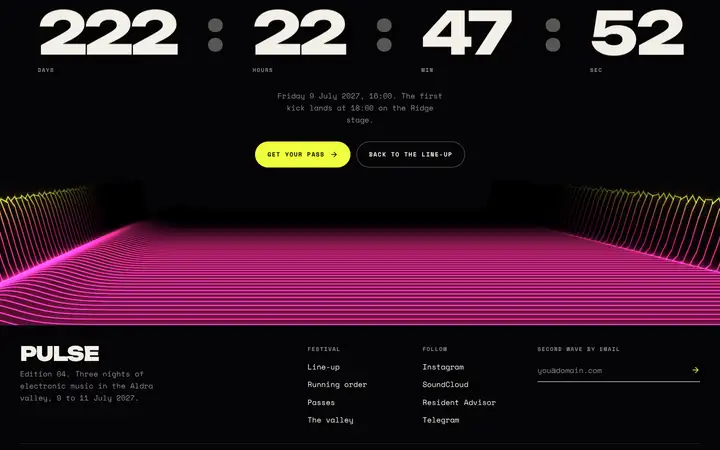
- **Countdown**: days (three digits), hours, minutes, seconds to Friday 9 July 2027, 16:00 CEST; once past, to the same date a year later. Each digit has a slot 0.78em wide, clipped vertically only (`clip-path: inset(0 -0.25em)`, letter-spacing 0 on the figure, since the round figures of Unbounded are wider than the slot): the old figure leaves upwards, the new one arrives from below (0.5 s `snap`). Unit labels under each group, colons at 35% opacity. The ticker reads the clock.
- **Scroll**: while the screen leaves, the word moves up 28% of its height more than the page; the foot blocks fade and rise 40 px over the first 40% of the section (both scrubbed).
### 5.4 Manifesto
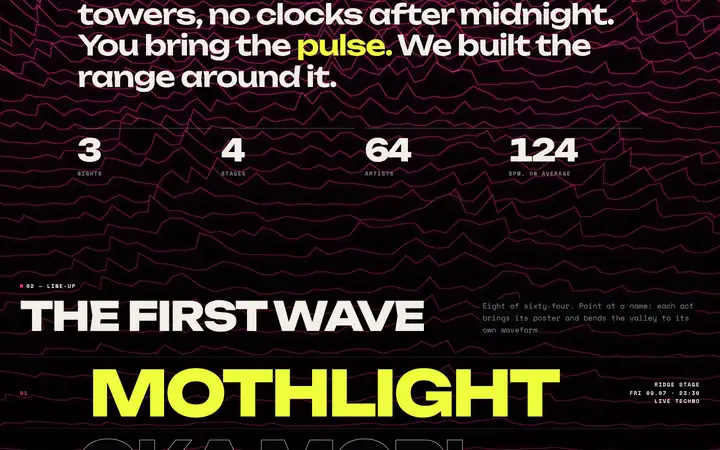
`150vh` with a sticky inner of `100vh`, content centred, transparent: the fly-over shows behind. Columns 2 to 11: the tag, then the statement with each word in its own span, three of them `volt`. Below, four figures in a row (2 x 2 under 900 px), each above a rule at 35% `fg` and a muted label.
Scrubbed over the wrapper ("top top" to "bottom bottom"): the words go from opacity 0.16 to 1 one after the other between 4% and 74% of the progress; from 50% the figures rise 30 px, fade in and count up from 0, 5% apart.
### 5.5 Line-up
Padding top `clamp(64px, 8vw, 120px)`. Head: the tag, the title on columns 1 to 8, a paragraph on a strip on columns 9 to 12.
**The list**: eight rows separated by 1 px rules, each on the grid: index (label, muted) in column 1, the name in columns 2 to 10, three right-aligned labels in columns 11 and 12 (stage, date and hour, genre). Under 900 px the name spans columns 2 to 12, the labels sit under it on one line, genre hidden. All names share one size: measure the widest at 100 px and scale it to the name column minus the shift below, capped at 14% of the viewport height. At rest the letters are filled with `bg` and outlined (`-webkit-text-stroke: 2px` in `fg` at 82%, `paint-order: stroke fill`): black shapes cut out of the terrain. A label on a strip closes the list.
**One name is always active**: the row at the pointer's height if a mouse has moved, otherwise the row crossing 46% of the viewport height, so scrolling alone walks through the list; the nearest row when none is there. The active name is filled `volt` without stroke and steps `clamp(8px, 1.6vw, 28px)` to the right (gsap, 0.7 s `snap`; colours switch at once); its index turns `accent`, its labels `fg`. `store.artist` selects the poster; `store.lineup` is 1 while the list lies between 30% and 78% of the viewport, and then the terrain takes the artist's two colours and waveform (rate 5 per second). `store.posterY` is the centre of the active row, clamped between 40% and 60% of the height and never above the top of the list plus half a poster.
**Posters** (pattern; background, figure, spot, ink of the type) and **terrain** (line, peak; frequency, sharpness):
0. Mothlight: two sets of rings, their moire and a lamp; `#0A0A0A`, volt, fg, fg. Terrain volt, `#FFFFFF`; 1.4, 0.9.
1. Oka Mori: a halftone sun of 27 x 36 dots; accent, volt, `#0A0A0A`, `#0A0A0A`. Terrain accent, volt; 0.8, 0.3.
2. Nightbus: thirteen bouncing spectrum bars of 30 segments; `#0C0C1C`, `#2D4BFF`, volt, fg. Terrain `#2D4BFF`, volt; 1.0, 1.0.
3. Halogen: tilted tubes of light; `#1A0010`, accent, `#FFFFFF`, fg. Terrain accent, `#FFFFFF`; 1.2, 0.6.
4. Low Orbit: thin ellipses, a sun, one orbiting planet; `#0B0B10`, fg, `#FF6A1A`, fg. Terrain fg, `#FF6A1A`; 0.5, 0.0.
5. Pale Sun: a striped sun in a two-colour sky; `#FF6A1A`, accent, volt, `#0A0A0A`. Terrain `#FF6A1A`, volt; 0.6, 0.15.
6. Orchid FM: bands bent by noise; `#8A3DFF`, accent, volt, fg. Terrain `#8A3DFF`, accent; 1.6, 0.7.
7. Tallow: thirteen small printed ridgelines; fg, `#0A0A0A`, accent, `#0A0A0A`. Terrain fg, accent; 2.0, 1.0.
**The type of the posters** is drawn on one 2D canvas of 2048 x 1360, an atlas of 4 x 2 cells of 512 x 680 holding masks: red is ink, green the black band at the foot (draw the ink with `globalCompositeOperation = "lighter"`). In a cell, margin 28: the brand and "04" top left, the date top right (Space Mono 700, 15 px), a 2 px rule under them; a ghost numeral "01" to "08" (Unbounded 900, 132 px, 42% ink) top right; the name in Unbounded 900, one word per line, each fitted to the width (maximum 176 px), stacked upwards from the band with a leading of 0.82; a band 118 px high with the stage and hour (700, 22 px), the genre and "ADMIT ONE · NO RE-ENTRY · 18+" (12 px), and a barcode 104 x 74 from a seeded random. The shader paints the band near black, the ink in the artist's ink colour, ink inside the band in `fg`.
### 5.6 Running order
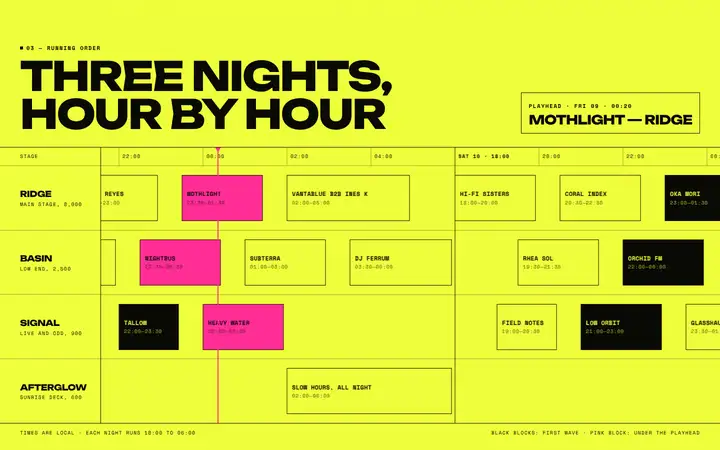
The only section in the **yellow theme** and the densest: a timetable drawn like the arrangement view of a sequencer.
- **Wrapper**: `182vh`, `margin-top: -40vh`, `z-index: 2`, `volt-ink` text, `pointer-events: none` (its content takes them back once the section is within 20% of the top). Inside: a fixed full-viewport row of **18 bars** (`volt`, `scaleY(0)`, origin bottom, each overlapping the next by 1 px) and a sticky inner of `100vh` with hidden overflow holding the content.
- **The wipe** (scrubbed, "top 64%" to "top top"): each bar grows to full height in 60% of the range (`power2.inOut`), bar `i` starting at `0.4 * |sin(2.4 i + 1) * cos(0.7 i)|` of it, like the bands of a spectrum. The content fades in between "top 22%" and "top 2%" while the two lines of the title rise behind their masks. As the section leaves ("bottom bottom" to "bottom top") the row of bars is translated up with it (`yPercent: -100`).
- A solid layer moving above a transparent WebGL canvas can make a browser skip part of the canvas: give the row of bars, the teeth of 5.7 and the solid navigation bar `opacity: 0.999`.
- **Head**, padding top `clamp(4.5rem, 9vh, 6.5rem)`: on 8 columns a tag with an ink square and the title on two masked lines; on 4 columns, aligned to the foot, the **readout**: a box with a 1.5 px rule, a label such as "Playhead · SAT 10 · 04:10", and below, in Unbounded 800 `clamp(1rem, 0.8rem + 0.9vw, 1.6rem)`, the act under the playhead and its stage, or "Changeover".
- **The board** takes the remaining height between two 1.5 px rules: a fixed left column `clamp(6.5rem, 14vw, 13rem)` wide (a "Stage" micro label, four stage names in Unbounded 800 `clamp(0.6875rem, 0.5rem + 0.6vw, 1.0625rem)`, a micro note under each from 900 px) and a clipped view holding the track. The track covers three nights of 720 minutes (18:00 to 06:00) at 1.4 px per minute from 900 px, 0.95 below. Rows: a ruler 2.25rem high (a tick and the hour every 2 hours, day and "18:00" in bold at the start of each night, a 1.5 px rule down the board there) and four lanes separated by rules at 35% ink.
- **Slots**: `left = (night * 720 + start) * ppm`, `width = minutes * ppm - 6`, from 14% to 86% of the lane, 1.5 px ink border, the act in Space Mono 700 0.75rem uppercase with ellipsis, the hours under it in 0.625rem at 70%. First-wave acts are inverted (ink fill, `volt` text). Hover: `fg` fill.
- **Track and playhead** (scrubbed from 12% of a screen after "top top" to "bottom bottom", progress `p`): the track moves from 0 to `-(track width - view width)` while the playhead, a 2 px `accent` line with a small triangle on top, goes from 3% to 97% of the view width, so it reads the three nights from Friday 18:00 to Monday 06:00. The readout shows the day, the hour rounded down to 10 minutes and the act under the playhead (a first-wave act wins when several play); every slot under it turns `accent`.
### 5.7 Passes
`135vh` with a sticky inner of `100vh` (min 600 px), content centred, transparent: the calm sea lies at the foot of the screen. Under 900 px there is no pin (natural height, padding 4.5rem and 3rem).
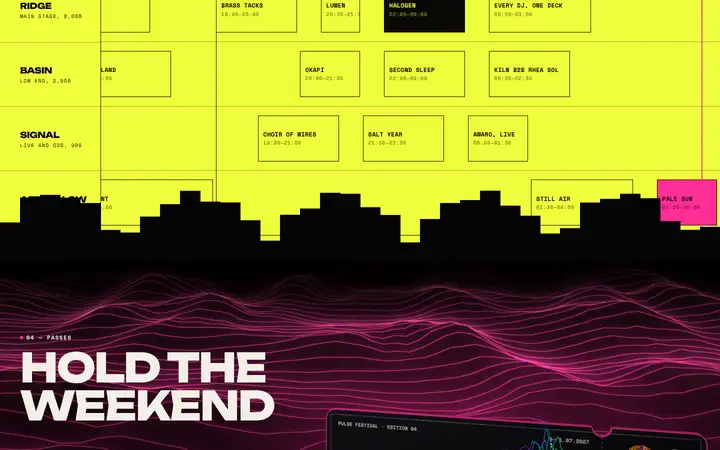
- **Teeth**: above the top edge (`bottom: 100%`, `16vh` high), a row of 36 `bg` bars, origin bottom, biting into the yellow section like a skyline. Scrubbed while the section comes in ("top bottom" to "top 25%"): tooth `i` goes through the heights `0, a, b, c` with `a = 0.25 + 0.75 |sin(1.9 i)|`, `b = 0.2 + 0.8 |cos(2.7 i + 1)|`, `c = 0.3 + 0.7 |sin(0.83 i + 2)|` (`sine.inOut`): the edge dances like an equaliser, then stands.
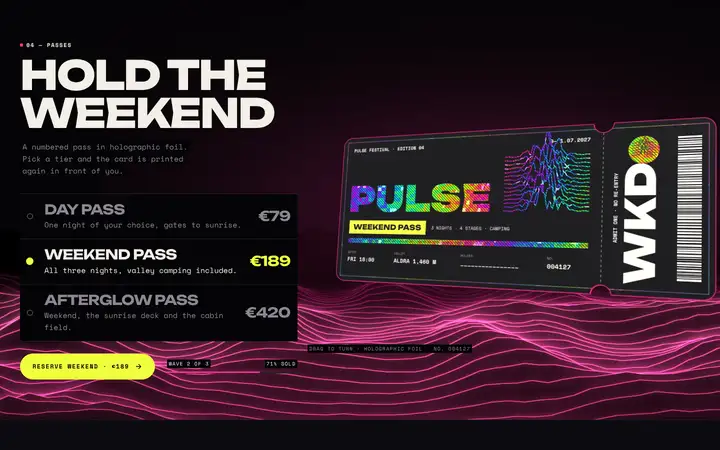
- **Left, columns 1 to 5**: the tag, the title, a paragraph on a strip, then the three tiers as a radio group on a `bg` plate: each row is a button (0.9rem of side padding) with a 0.7rem ring, the name (sub style) above one line of description and the price on the right; 1 px rules between rows. Hover: `fg` text, the name moves 0.4rem. Checked: `fg` text, the ring filled `volt` and scaled 1.35 (`kick`), the price `volt`. Below: the main button, whose label follows the tier, and a meter: two micro labels on strips above a 3 px track with an `accent` fill at `scaleX(0.71)`.
- **Right, columns 6 to 12, the slot**: an empty box `min(64vh, 46vw)` high (placed above the copy and `min(34vh, 62vw)` high under 900 px), `touch-action: pan-y`, grab cursor, with a micro caption on a strip at its lower left. The scene keeps the pass on it.
- **Choosing a tier** spins the card once (`spin += 2π`, 1.2 s `power3.inOut`); the new pass is printed while the card shows its edge (`|cos(spin)| < 0.25`). **Dragging** the slot sideways turns the card (0.011 rad per pixel); on release it settles on the nearest face (a multiple of π, 1.3 s `elastic.out(1, 0.55)`), so the back can be read.
- **The print**: two 2D canvases of 1600 x 1400 (front in the upper half, back in the lower), one for the art, one for the foil mask (white = foil). Card, ink, spot per tier: Day `fg`, `#0A0A0A`, accent; Weekend `#0B0A0D`, `fg`, volt; Afterglow volt, `#0A0A0A`, accent.
Front (tear line at x 1200): diagonal hairlines every 14 px at 5% ink; a 2 px frame 24 px inside at 40% ink, grey in the mask so it glints; at y 56, Space Mono 700 22 px, the festival line on the left and the dates on the right; the brand in Unbounded 900 fitted to 700 px (maximum 236 px), baseline y 366, white in the mask, 20% ink in the art; a mark of 15 ridgelines in a 350 x 270 box at (800, 104), foil; the tier name in Unbounded 800 34 px knocked out of a spot-colour block at (58, 408), 64 high, then the perks in 20 px; a foil strip at (58, 494), 1092 x 22, with the brand repeated in 13 px knocked out; four fields at y 556 (label 15 px at 60%, value 700 26 px) at x 58, 300, 620, 990. Stub: a dashed perforation, "ADMIT ONE · NO RE-ENTRY" and the tier code (Unbounded 900, 150 px) rotated 90 degrees, a barcode 82 px wide down the right, a round foil seal of radius 56.
Back: the frame, a foil band across the width (y 96 to 216), the brand as a ghost at the foot (10% ink, fitted to 1040 px), a title and four lines of terms from (58, 268), and a 21 x 21 scan pattern of 10 px cells with three finder squares, captioned.
### 5.8 The valley
The only opaque dark section: `panel` background, a 1 px rule on top, padding `clamp(56px, 7vw, 104px)` above and `clamp(32px, 4vw, 64px)` below.
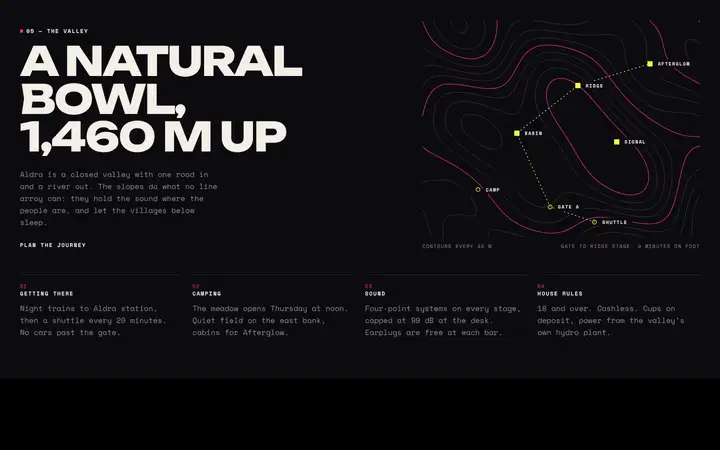
- Left, columns 1 to 7: the tag, the title on two sentences (break after the comma), a muted paragraph (max 44ch), a label link in `volt`.
- Right, columns 8 to 12: **a contour map generated in code** as inline SVG, viewBox 640 x 500. A height function (a bowl, two sine products, a small hill top right) is sampled on a 64 x 50 grid; eleven levels from 0.12 in steps of 0.1 are traced by marching squares, one path per level; every fourth level is `accent` at 90%, 1.4 px, the others `fg` at 22%, 1 px. Over it: a dotted `volt` route (dash 2 7) from the shuttle stop through the gate to the stages; four stages as 12 px `volt` squares and three other points as 9 px rings, each with a label on a `panel` plate. A two-part micro caption below.
- Under both, four facts in a row (two under 1100 px, one under 640 px): a number in `accent` micro, a label title, muted text (max 34ch), a 1 px rule above over which a `volt` rule is drawn from the left on hover (0.7 s `snap`).
- Entrance of the map, once, when its top passes 82% of the viewport: the levels fade in 0.07 s apart, then the points pop from scale 0 (`back.out(2)`, 0.08 s apart).
### 5.9 Countdown and footer
**Closing**, `88vh`, transparent, centred, padding top `clamp(64px, 12vh, 132px)`: the tag on a strip, the large countdown, one muted sentence on a strip (max 38ch), the main button and a ghost button. Behind it the terrain has gone flat; the heartbeat crosses it and the pointer still raises a wave.
**Footer**, opaque `bg`, 1 px rule on top, padding `clamp(1.5rem, 3vw, 2.5rem)`: the brand in Unbounded 900 `clamp(1.5rem, 3vw, 2.5rem)` and one muted sentence (4 columns); a column "Festival" with the four anchors; a column "Follow" with four names as buttons; a newsletter field (3 columns): label, an input with a 1 px `fg` underline and an arrow button in `volt`, replaced by the confirmation in `volt` on submit. Last row above a rule: the legal line and "Back to top".
## 6. Motion
**Intro**: one gsap timeline started on load and complete at 2.9 s.
- 0 to 1.2 s: the lines are drawn from their centre outwards, near lines first (`intro.reveal` 0 to 1, `power2.out`).
- 0 to 2.6 s: the camera comes down from 5 higher, 7 further back and 0.3 rad steeper (`intro.cam` 1 to 0, `expo.out`).
- 0.3 to 1.8 s: the range springs up from flat (`intro.amp` 0 to 1, `back.out(2.4)`).
- 0.7 to 2.2 s: the letters of the word rise from 78% lower, 0.06 s apart, 1.25 s each, `expo.out`. They are behind the canvas: the range itself is their mask.
- 0.4 to 2.0 s: the figure of "124 BPM" counts up from 0.
- 1.3 s: navigation links rise behind masks (`yPercent` 110, 0.8 s, 0.06 s apart); 1.55 s: the tag and the three lines of the claim do the same (0.07 s apart); 1.9 s: buttons, countdown, edge labels and brand fade in and rise 14 px (0.55 s, 0.04 s apart).
**Pointer**: the wave of 5.1 wherever the terrain shows (strength 1 on the first and last screens, 0.4 to 0.7 elsewhere, 0 where it is hidden); the camera leans; the poster and the pass tilt.
**Scroll** (lenis `lerp: 0.11`, every scrub tied directly to the scroll position): the first screen leaves while the camera rises (1 screen); the manifesto pin (0.5 screen); the line-up, where the camera drifts 14 units in plan view; the yellow wipe (0.64 screen), then the pinned track (0.7 screen); the teeth, then the pass flying in with a turn of 2.6 rad and turning 0.7 rad more while pinned (0.35 screen); the map; the field flattening over the 0.7 screen before the closing.
**Ordinary entrances**: titles rise line by line behind masks (SplitText lines, `yPercent` 110, 0.9 s `expo.out`, 0.08 s apart); small blocks rise 28 px and fade (0.8 s); once, when 10 to 12% inside the viewport.
**Reduced motion** (`prefers-reduced-motion: reduce`): no lenis, no intro (final state at once), no pins (sticky wrappers take their natural height; the yellow section is a plain yellow block whose board, 26rem high, scrolls sideways natively, without bars, teeth or playhead, the readout saying "Scroll the board sideways"), no reveals, no rolling digits. The scene is a composed still: time frozen at 21.4, the pose snapped to the nearest keyframe, no pointer wave, no sway, and a frame is drawn only when the scroll, the size or a choice has changed.
## 7. Responsive behaviour
- **From 1100 px**: as described. **900 to 1099 px**: no cue on the first screen; facts on two columns.
- **Under 900 px**: links move to the menu; no edge labels; the foot of the first screen stacks (tag, claim, buttons, countdown); manifesto on the full width; names on columns 2 to 12 with their labels below; the board at 0.95 px per minute; the slot of the pass above the copy, no pin; the map under the text; footer stacked.
- **Under 640 px**: the dates leave the navigation; facts on one column; buttons may wrap.
- Touch: nothing depends on hover. The active name follows the scroll, the pass turns with a horizontal drag while vertical gestures still scroll.
- No horizontal overflow from 360 px.
## 8. Accessibility and performance
- Structure: one `h1` (the brand, with `aria-label`; its letters `aria-hidden`), an `h2` per section (visually hidden in the closing), `h3` for names and facts; the acts are an ordered list; the tiers a `radiogroup` of `role="radio"` buttons; the slot of the pass has `role="img"` and a label describing the card; each countdown has `role="timer"` and a label; the canvas wrapper is `aria-hidden`.
- Keyboard: every control reachable; `:focus-visible` outline 2 px `volt` (ink on yellow), offset 3 px.
- **Budgets**: those of 5.1 (pixel ratio 1.75, one canvas, 5 draw calls, about 92,000 triangles, no post-processing, rest when hidden or empty); DOM animation on transform and opacity only; no blur; about 9 screens on desktop, never more than 10.
- **Without WebGL** (context creation fails) the scene is not mounted. The first screen draws the same range once on a 2D canvas over the word: 64 rows from far to near, each filled with `bg` under its line, so that it hides what is behind, and stroked 1.2 px with a vertical gradient from `volt` to `accent` and a soft glow. The slot shows the printed front of the pass as an image, a flat rainbow in place of the foil, tilted with a CSS perspective transform. The line-up works without posters. Nothing is blank.
- Fitted sizes are computed again on `document.fonts.ready`; the layout must not jump.
## 9. Copy deck
Tokens: `[BRAND] :: Pulse` · `[EDITION] :: 04` · `[DATES] :: 09—11 July 2027` · `[DATES_SHORT] :: 09—11.07.27` · `[PLACE] :: Aldra valley` · `[ALTITUDE] :: 1,460 m` · `[GATES] :: Friday 9 July 2027, 16:00`
- Title: `[BRAND] — Three nights of sound in a valley that answers back` · Description: `[BRAND], edition [EDITION]: a festival of electronic music in the [PLACE], 9 to 11 July 2027.`
- Navigation: `[BRAND]` `04` · Line-up · Running order · Passes · The valley · `[DATES_SHORT]` · button `Passes` · menu foot `[DATES] · [PLACE], [ALTITUDE]`
- First screen: edge labels `N 46°58′ · E 10°52′ · 1,460 m` and `124 BPM · Edition 04` · tag `Festival of electronic music · [DATES]` · claim `Three nights of sound` / `in a valley` / `that answers back.` · buttons `Get your pass`, `See the line-up` · `Gates open in` · units `Days` `Hours` `Min` `Sec` · cue `Move · scroll`
- Manifesto: `01 — Manifesto` · `Three nights in a valley that answers back. Four stages cut into the slope, tuned so the mountain carries the low end. No screens above the DJ, no VIP towers, no clocks after midnight. You bring the pulse. We built the range around it.` (yellow: `answers`, `back.`, `pulse.`) · figures `3 Nights` · `4 Stages` · `64 Artists` · `124 BPM, on average`
- Line-up: `02 — Line-up` · title `The first wave` · `Eight of sixty-four. Point at a name: each act brings its poster and bends the valley to its own waveform.` · closing label `Fifty-six more names on 1 March`
- Acts (name, stage, date, hour, genre; rows read "Ridge stage" and "Fri 09.07 · 23:30"): `Mothlight, Ridge, Fri 09.07, 23:30, Live techno` | `Oka Mori, Ridge, Sat 10.07, 23:00, House, disco` | `Nightbus, Basin, Fri 09.07, 22:30, UK bass` | `Halogen, Ridge, Sun 11.07, 22:00, Synth pop, live` | `Low Orbit, Signal, Sat 10.07, 21:00, Ambient, modular` | `Pale Sun, Afterglow, Mon 12.07, 04:30, Sunrise set` | `Orchid FM, Basin, Sat 10.07, 22:00, Electro` | `Tallow, Signal, Fri 09.07, 22:00, Noise, post-punk`
- Running order: `03 — Running order` · title `Three nights,` / `hour by hour` · readout `Playhead · SAT 10 · 04:10`, then `Marlowe — Ridge` or `Changeover` · `Stage` · stages `Ridge: Main stage, 8,000` | `Basin: Low end, 2,500` | `Signal: Live and odd, 900` | `Afterglow: Sunrise deck, 600` · nights `Fri 09` `Sat 10` `Sun 11` · foot `Times are local · Each night runs 18:00 to 06:00` and `Black blocks: first wave · Pink block: under the playhead`
- Slots (first wave marked *). Friday. Ridge: 19:00-20:30 Soft Machine Club, 21:00-23:00 Dalia Reyes, 23:30-01:30 Mothlight*, 02:00-05:00 Vantablue b2b Ines K. Basin: 20:00-22:00 Kiln, 22:30-00:30 Nightbus*, 01:00-03:00 Subterra, 03:30-06:00 DJ Ferrum. Signal: 18:30-20:00 Paper Cranes, 20:30-21:30 Amaro, 22:00-23:30 Tallow*, 00:00-02:00 Heavy Water. Afterglow: 02:00-06:00 Slow Hours, all night.
- Saturday. Ridge: 18:00-20:00 Hi-Fi Sisters, 20:30-22:30 Coral Index, 23:00-01:30 Oka Mori*, 02:00-04:30 Marlowe. Basin: 19:30-21:30 Rhea Sol, 22:00-00:00 Orchid FM*, 00:30-02:00 Tape Loop Trio, 02:30-05:00 Null Island. Signal: 19:00-20:30 Field Notes, 21:00-23:00 Low Orbit*, 23:30-01:00 Glasshaus, 01:30-03:00 Ada Venn. Afterglow: 02:30-06:00 Dew Point.
- Sunday. Ridge: 18:00-20:00 Brass Tacks, 20:30-21:30 Lumen, 22:00-00:00 Halogen*, 00:30-03:00 Every DJ, one deck. Basin: 20:00-21:30 Okapi, 22:00-00:00 Second Sleep, 00:30-02:30 Kiln b2b Rhea Sol. Signal: 19:00-21:00 Choir of Wires, 21:30-23:30 Salt Year, 00:00-01:30 Amaro, live. Afterglow: 01:30-04:00 Still Air, 04:30-06:00 Pale Sun*.
- Passes: `04 — Passes` · title `Hold the weekend` · `A numbered pass in holographic foil. Pick a tier and the card is printed again in front of you.` · tiers (code, name, price, line, perks printed on the card): `DAY, Day pass, €79, One night of your choice, gates to sunrise., 1 night · 4 stages` | `WKD, Weekend pass, €189, All three nights, valley camping included., 3 nights · 4 stages · camping` | `AAA, Afterglow pass, €420, Weekend, the sunrise deck and the cabin field., 3 nights · sunrise deck · cabins` · button `Reserve day · €79`, `Reserve weekend · €189` or `Reserve afterglow · €420` · `Wave 2 of 3` · `71% sold` · caption `Drag to turn · Holographic foil · No. 004127`
- On the pass: `[BRAND] FESTIVAL · EDITION 04` · `09—11.07.2027` · fields `GATES: FRI 16:00` · `VALLEY: ALDRA 1,460 M` · `HOLDER: ________________` · `NO.: 004127` · `ADMIT ONE · NO RE-ENTRY` · back: `READ THIS BEFORE THE BASS DOES` · `This pass is personal and admits one person. It is exchanged for a wristband at Gate A; the stub stays with the valley.` · `Lost passes are not replaced. Resale only through the festival desk.` · `Quiet hours do not exist. Earplugs are free at every bar.` · `SCAN AT GATE A`
- The valley: `05 — The valley` · title `A natural bowl,` / `1,460 m up` · `Aldra is a closed valley with one road in and a river out. The slopes do what no line array can: they hold the sound where the people are, and let the villages below sleep.` · link `Plan the journey` · map points `Ridge` `Basin` `Signal` `Afterglow` `Camp` `Gate A` `Shuttle` · captions `Contours every 40 m` and `Gate to Ridge stage: 9 minutes on foot`
- Facts: `01 Getting there: Night trains to Aldra station, then a shuttle every 20 minutes. No cars past the gate.` | `02 Camping: The meadow opens Thursday at noon. Quiet field on the east bank, cabins for Afterglow.` | `03 Sound: Four-point systems on every stage, capped at 99 dB at the desk. Earplugs are free at each bar.` | `04 House rules: 18 and over. Cashless. Cups on deposit, power from the valley's own hydro plant.`
- Closing: `06 — Gates open in` · `[GATES]. The first kick lands at 18:00 on the Ridge stage.` · buttons `Get your pass`, `Back to the line-up`
- Footer: `[BRAND]` · `Edition [EDITION]. Three nights of electronic music in the [PLACE], 9 to 11 July 2027.` · `Festival` (the four anchors) · `Follow`: Instagram, SoundCloud, Resident Advisor, Telegram · `Second wave by email` · placeholder `you@domain.com` · confirmation `You are on the list. See you in the valley.` · `© 2027 [BRAND] Festival · [PLACE] · 18+ · Look after each other` · `Back to top`
## 10. Acceptance checklist
- [ ] Three seconds after load the yellow word stands behind a range of magenta ridgelines with yellow peaks; the horizon cuts the feet of its letters.
- [ ] The intro of section 6 is complete at 2.9 s.
- [ ] The pointer raises a mound of hot spikes that follows it, with a ring and a wake.
- [ ] Scrolling takes the camera over the range, to a plan view, to a low sea, to a flat field with a travelling heartbeat; the terrain never pops.
- [ ] Lines hide the lines behind them and glow.
- [ ] In the line-up one name is always active; the poster changes with an 18-band wipe; the terrain takes the artist's colours and waveform.
- [ ] The yellow section arrives through 18 rising bars; while pinned the track slides, the playhead crosses it and the readout names the act under it.
- [ ] The black teeth dance into the yellow section as the passes arrive.
- [ ] The pass stays on its slot at every scroll position; its foil changes with the angle; a tier spins and reprints it; a drag turns it to its back.
- [ ] Both countdowns run, digits rolling in fixed slots; the contour map is generated.
- [ ] No request leaves the site; no image, video or model file; no CSS keyframes, CSS transitions on hover only.
- [ ] One canvas, at most 5 draw calls, about 92,000 triangles, pixel ratio capped at 1.75; no drawing when the tab is hidden or under the yellow and valley sections.
- [ ] `prefers-reduced-motion`: a still scene, no pins, no scrubbed animation, everything readable.
- [ ] Without WebGL: the 2D range on the first screen and the flat pass in its slot.
- [ ] No horizontal scroll from 360 px; every section works on a phone; about 9 screens on desktop.
- [ ] The production build passes with no TypeScript error.