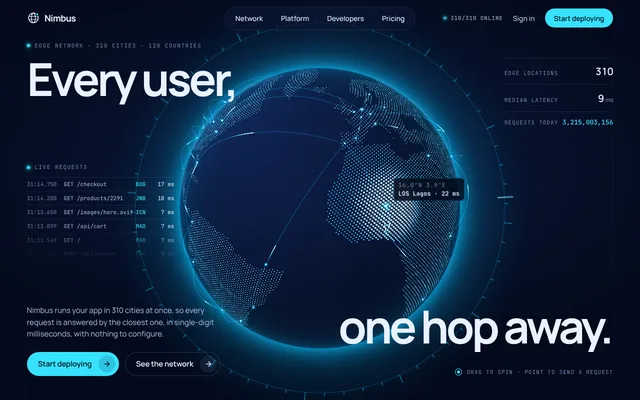
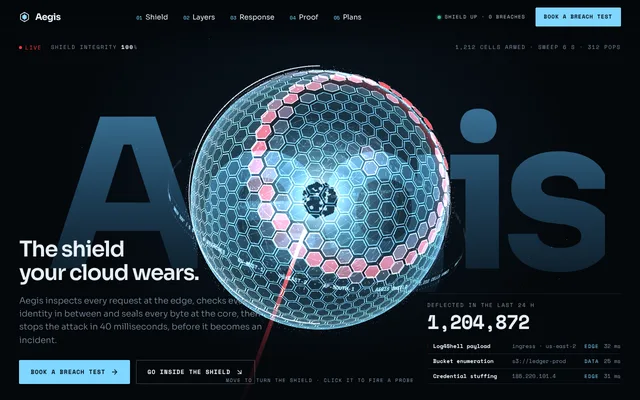
Pull a live 3D agent graph, ride one run through it, watch it fold into the logo.
Real-time 3D
Shader
Scroll story
Particles
by Prompto · Pro · 805 lines
Film of the live demo
This is the real site, running live: nothing here is a video. An AI coding agent designed and built it, and the prompt is its exact specification, scene code included. Launch it to scroll, drag and resize it yourself.
Overview
A complete AI-agent platform site built around one real-time WebGL graph of glossy nodes and pulsing edges that leans towards the pointer. Scrolling flies the camera through a four-step run, docks a card beside each node, then folds the graph into the S logo.
Best for
AI startups, developer tools, SaaS platforms
Signature move
A 3D node graph that pulls toward the cursor, lights a run node by node and folds into the S logo mark on scroll
Hero
Two lines of huge type, “Draw the graph.” top left and “Ship the agent.” bottom right, frame a live 3D graph of glossy nodes and thin tubes carrying lime pulses; nodes near the pointer drift to it and the nearest lights up with a mono tag.
Type
Space Grotesk
What it builds
01Hero graph
02How a run works
03Platform track
04Evals & traces
05Pricing
06Start
07Footer
The prompt
805 lines · 10,972 words
How to use it
01
Copy
Pick your builder, add your brand if you like, and press Copy.
02
Paste
Send it as one message in a new, empty project. Let the builder finish.
03
Swap the words
Search for the [BRACKETS] and replace what is left with your own copy.
Yes. An AI coding agent designed and built this site, and the prompt is the exact specification of it: every colour, size, string and timing, plus the source code of the 3D scene. It was built on 27 November 2026. Your own run will be very close; AI builders vary a little from one run to the next.
Where do the 3D and the images come from?
From code. The scene is real-time 3D: geometry, materials, lighting and shaders are all written in the prompt, and any graphic you see is drawn by the site itself. Nothing is a video and nothing is downloaded from a third party, so nothing can go missing or need a licence.
Will it run smoothly?
The prompt sets a budget for the scene (pixel ratio, draw calls, shader cost), pauses it when it is off screen, and specifies a calm version for visitors who ask for reduced motion and a designed fallback where 3D is unavailable. Launch the live demo on your own machine to judge.
Does it need Next.js?
It is written for Next.js · Three.js · GSAP. The versions for Lovable and Bolt tell the builder to use plain React with Vite instead, without changing the design.
Can I change the design afterwards?
Yes. The result is ordinary code in your project. Keep talking to your builder, or change the tokens section of the prompt before you paste it to recolour the whole site.
Pro opens this prompt and every other one in the library.
€149€299once, every prompt for good
This prompt and all the others
Every Monday drop included
Commercial licence for client work
prompt.md805 lines · preview
# Synapse — an AI-agent platform whose page is one live graph: the visitor pulls its nodes, rides one run through four steps, and watches the graph fold into the logo
> Paste this whole prompt as one message into a new, empty project.
## 1. Role and goal
You are a senior creative developer and art director. Build the complete one-page marketing site of **[BRAND]**, a platform where teams build AI agents as graphs: every model call, tool and decision is a node you can see, test and trace. The page is one real-time WebGL graph of about a hundred glossy nodes joined by thin tubes, with pulses of light running along the edges. On the first screen the graph floats between two lines of huge type and leans towards the pointer: nodes within reach drift to the cursor, the nearest one lights up in electric lime and a mono tag names it, and a click fires a burst of pulses from it. Scrolling pins a walk-through: the camera flies into the graph and dollies from node to node while one run (a refund ticket) travels the lime spine, each step's node lights up and its card docks beside it; then the whole graph folds, layer by layer, into the S-shaped logo mark. The mark parks in a corner and turns once while a horizontal track of six platform cards slides past, a paper-coloured evaluation section opens from a rounded panel to full bleed, pricing follows, and the mark returns centre stage for the closing call to action. Everything is generated in code, and it must read as the site of a real company: confident type, exact numbers, no filler.
## 2. Stack and constraints
- Next.js (App Router) with TypeScript and Tailwind CSS v4 (`@import "tailwindcss"`, tokens in `@theme`, your own rules inside `@layer base` / `@layer components` so utilities still win); `three`, `@react-three/fiber`, `@react-three/drei` (only `Environment` and `Lightformer`); `gsap` with `ScrollTrigger` and `SplitText`; `lenis` for smooth scrolling; `lucide-react` for five icons (ArrowRight, ArrowUpRight, Check, Menu, X).
- Fonts: **Space Grotesk** (variable, 300 to 700) for display and text, **JetBrains Mono** (variable) for labels, data and the 3D tags. Load them with `next/font` (or self-host the Latin `.woff2` of the `@fontsource-variable` packages in a Vite project), Latin subset only, `display: block`.
- The scene is one client component in its own chunk, imported dynamically with server rendering off (`next/dynamic` with `ssr: false`), mounted at once.
- **No external assets: every visual is generated in code.** Geometry from primitives and instancing; the 3D labels are drawn on a 2D canvas; the dot grid, haze, glows and edge pulses are shaders. Forbidden because they download files: drei `Environment` with `preset` or `files` (build it from `<Environment resolution={256} frames={1}>` with `<Lightformer>` children), `useGLTF`, `useTexture` with a URL, drei `<Text>` without a local font file, any `<link>` or `@import` to a font or script host, any image or video file.
- One page, one route. Every link is an in-page anchor or a button; nothing opens a new tab; no `alert`. Lenis (`lerp: 0.12`, driven from the GSAP ticker, calling `ScrollTrigger.update` on scroll) smooths the wheel but never blocks or hijacks the native scroll.
- One WebGL canvas for the whole page: `position: fixed; inset: 0`, transparent (`alpha: true`, clear alpha 0), `pointer-events: none`, under the content. No post-processing: every glow is a shader.
The full prompt is part of Prompto Pro.
805 lines covering tokens, layout, every section, motion, copy and a final checklist.