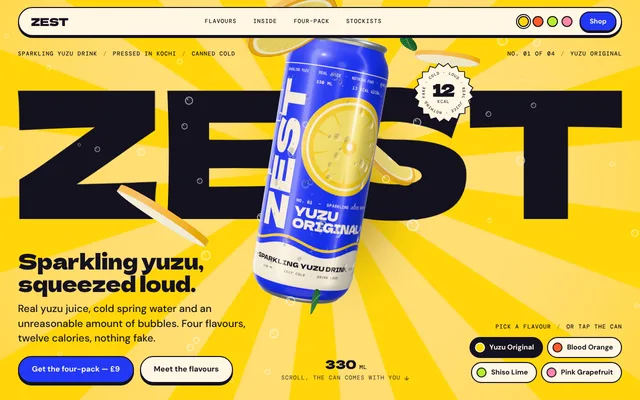
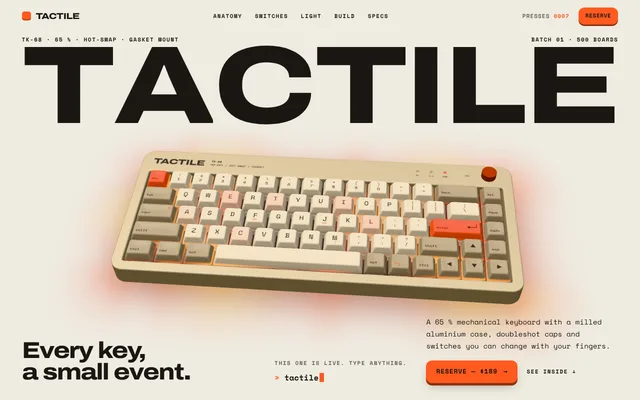
Drag a real-time glass flacon that bends the page behind it, from ivory studio to black.
Real-time 3D
Shader
Particles
Scroll story
by Prompto · Pro · 688 lines
Film of the live demo
This is the real site, running live: nothing here is a video. An AI coding agent designed and built it, and the prompt is its exact specification, scene code included. Launch it to scroll, drag and resize it yourself.
Overview
A perfume launch built around one object: a glass bottle with true refraction, sloshing amber perfume and a fluted brass cap, lit like a studio photograph. It travels down the page with the visitor, bends the giant serif type behind it and turns three pinned note chapters from bright ivory to glowing black.
Drag the glass bottle to spin it: the perfume sloshes and the giant type behind it refracts through glass and liquid.
Hero
A studio-lit glass flacon stands in front of the brand name set in huge Cormorant; the letters bend inside the clear glass and darken the amber perfume. On load it rises, turns and fills from 0 to 50 ml, then follows the pointer.
Type
Cormorant Garamond with Inter
What it builds
01Hero
02The trail
03The notes
04Composition
05The flacon
06Reserve
07Footer
The prompt
688 lines · 10,558 words
How to use it
01
Copy
Pick your builder, add your brand if you like, and press Copy.
02
Paste
Send it as one message in a new, empty project. Let the builder finish.
03
Swap the words
Search for the [BRACKETS] and replace what is left with your own copy.
Yes. An AI coding agent designed and built this site, and the prompt is the exact specification of it: every colour, size, string and timing, plus the source code of the 3D scene. It was built on 27 November 2026. Your own run will be very close; AI builders vary a little from one run to the next.
Where do the 3D and the images come from?
From code. The scene is real-time 3D: geometry, materials, lighting and shaders are all written in the prompt, and any graphic you see is drawn by the site itself. Nothing is a video and nothing is downloaded from a third party, so nothing can go missing or need a licence.
Will it run smoothly?
The prompt sets a budget for the scene (pixel ratio, draw calls, shader cost), pauses it when it is off screen, and specifies a calm version for visitors who ask for reduced motion and a designed fallback where 3D is unavailable. Launch the live demo on your own machine to judge.
Does it need Next.js?
It is written for Next.js · Three.js · GSAP. The versions for Lovable and Bolt tell the builder to use plain React with Vite instead, without changing the design.
Can I change the design afterwards?
Yes. The result is ordinary code in your project. Keep talking to your builder, or change the tokens section of the prompt before you paste it to recolour the whole site.
Pro opens this prompt and every other one in the library.
€149€299once, every prompt for good
This prompt and all the others
Every Monday drop included
Commercial licence for client work
prompt.md688 lines · preview
# Sillage — a perfume launch where a real-time glass flacon refracts the page it travels through
> Paste this whole prompt as one message into a new, empty project.
## 1. Role and goal
You are a senior creative developer and art director. Build the launch site of a perfume house that sells exactly one fragrance, complete and production-ready, in one pass. The site is one long studio photograph that moves. A glass flacon rendered in real time (lathe-turned glass with true transmission, amber perfume that keeps its level and sloshes, a fluted brass cap, a printed label) floats in front of the page and bends it: the page background and the giant serif words are painted inside the WebGL picture, behind the bottle, so the glass and the liquid really refract them. The visitor drags the bottle to turn it. It stays with them down the page, travelling from section to section, while the lighting goes from bright-field (ivory wall, dark glass edges) to dark-field (black wall, bright rims, the perfume glowing like a lamp). Choosing the 100 ml size makes the bottle grow. Follow the numbers: they are the design.
## 2. Stack and constraints
- Next.js (App Router) with TypeScript and Tailwind CSS v4 (`@import "tailwindcss";`, tokens in `@theme`, component classes in `@layer components` so utilities can override them). `three` with `@react-three/fiber` and `@react-three/drei`. `gsap` with `ScrollTrigger` and `SplitText`. `lenis` for smooth wheel scrolling (`lerp: 0.11`). Icons from `lucide-react`: ArrowDown, ArrowUp, Check, Rotate3d, 14 to 22 px, stroke 1.5.
- Fonts: Cormorant Garamond (variable, weights 300 to 700, roman and italic) as `--font-display`; Inter (variable) as `--font-body`. Load them with `next/font/google`, or from the self-hosted `@fontsource-variable` packages (Latin files only) in a Vite project. No other family.
- The scene is one client component, imported with `next/dynamic` and `ssr: false`. One `<canvas>` for the whole page: `position: fixed`, full viewport, `z-index: 0`, `pointer-events: none`, `aria-hidden`. Every section is transparent; the canvas draws the page background.
- No external assets: every visual is generated in code (lathe profiles, cylinders, points, shaders, 2D canvas textures). Forbidden because they download files: drei `Environment` with `preset` or `files` (build the environment from `<Environment resolution={256}>` with `<Lightformer>` children), `useGLTF`, `useTexture` with a URL, drei `<Text>` without a local font file, any font, script, image, model or HDRI from a remote host. No UI kit, no post-processing library, no stock images, no lorem ipsum.
- Single page. Every link is an in-page anchor or a button; the reservation form answers in place and sends nothing.
The full prompt is part of Prompto Pro.
688 lines covering tokens, layout, every section, motion, copy and a final checklist.