# Inès Moreau — an art director's portfolio on a paper globe of plates you can drag
> Paste this whole prompt as one message into a new, empty project.
## 1. Role and goal
You are a senior creative developer and art director. Build the portfolio of Inès Moreau, an independent art director in Paris: complete, production-ready, in one pass.
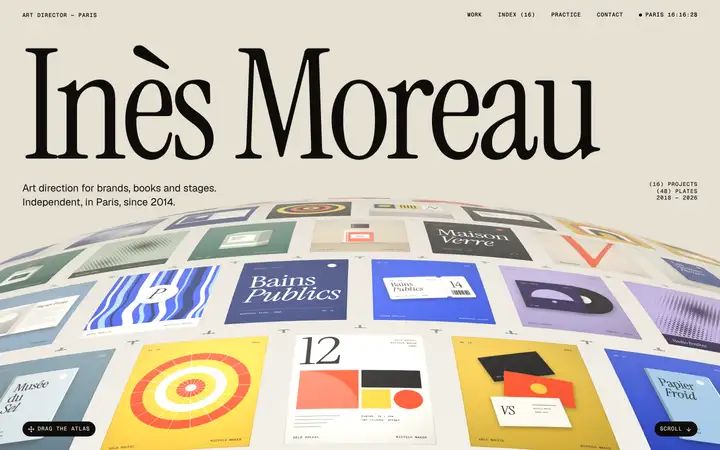
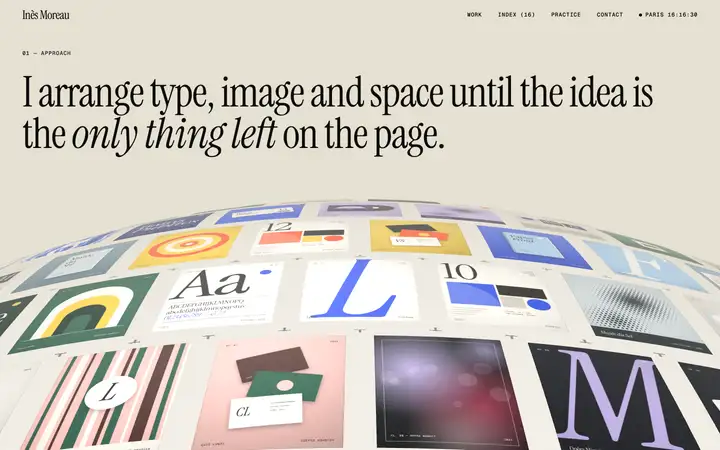
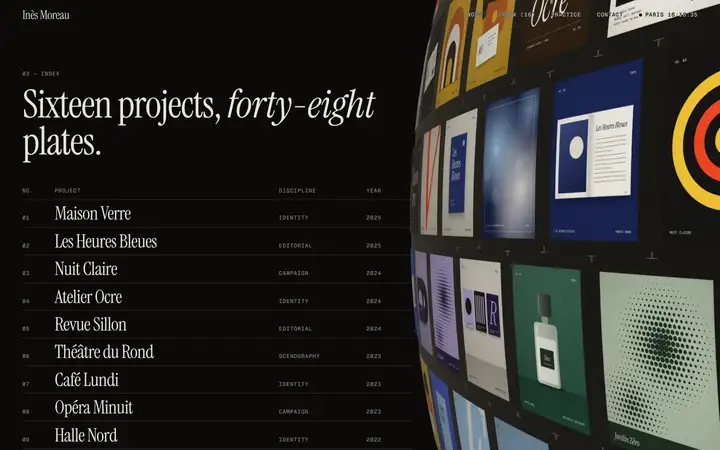
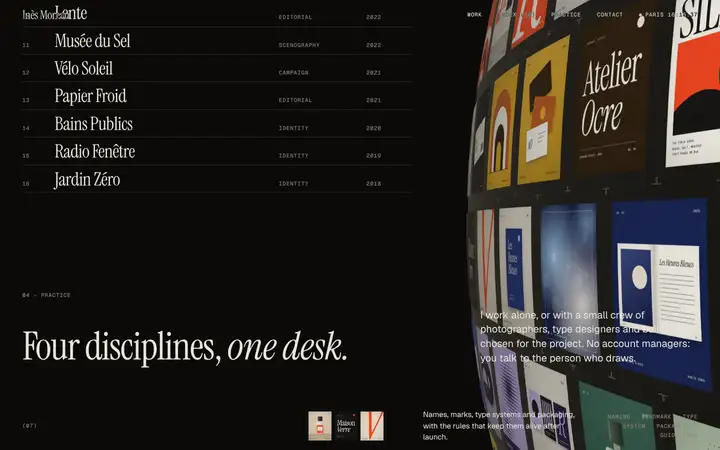
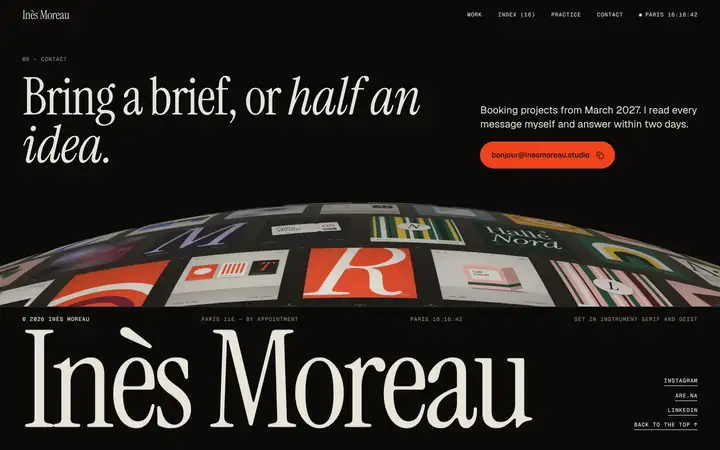
The whole site is one object: an endless plane of project plates (48 small posters, three per project) wrapped on a paper globe, in real time. The visitor drags it in any direction with inertia; fast moves bend it like a lens; a click flies into a plate and opens the project. The scroll looks at the globe from four places: over its horizon, from straight above, from the side at night, rising behind the last headline. Almost no interface: a name, an index, a clock. Bone and black, one vermilion accent, Instrument Serif set very large.
Follow the numbers: they are the design. Section 5.1 ends with the reference code of the scene.
## 2. Stack and constraints
- Next.js (App Router) with TypeScript and Tailwind CSS v4 (`@import "tailwindcss";`, tokens in `@theme`), `three` with `@react-three/fiber` and `@react-three/drei` (installed; the scene needs none of its helpers), `gsap` with ScrollTrigger and SplitText, `lenis`, `lucide-react` (Move, ArrowDown, ArrowUpRight, ArrowLeft, ArrowRight, Copy, Check).
- Fonts by name: Instrument Serif (400, roman and italic), Geist (variable; 400, 500), Geist Mono (variable; 500), loaded with `next/font`, or from self-hosted `@fontsource` packages in a Vite project (Latin files only). The plates are typeset on a 2D canvas: give the painter the real family names (with `next/font`, `font.style.fontFamily`) and wait for `document.fonts.load()` of the four faces before painting.
- The scene is one client component loaded without server rendering (`dynamic(..., { ssr: false })`): one `<canvas>` for the whole page, fixed behind the content.
- No external assets: every visual is generated in code; nothing is fetched at run time. Forbidden because they download files: drei `Environment` with `preset` or `files`, `useGLTF`, `useTexture` with a URL, drei `<Text>` without a local font file, any `<link>` or `@import` to a font or script host, any hot-linked picture. Plates painted with the 2D canvas API replace photographs.
- One page; the project page is an in-page dialog; links are in-page anchors or buttons.
- No UI kit, no lorem ipsum, no post-processing, no three.js lights (the shaders do the lighting).
## 3. Design tokens
Colour: bone and black, one accent; the plates bring every other colour.
- `bone #E6E0D3`: page background by day. `#E9E4D8`: text by night.
- `paper #F3EFE6`: light ground inside plates. Globe: `#F4F0E8` by day, `#181613` by night; its rim `#CDC6B6` and `#5E584D`.
- `ink #0E0D0B`: text by day, pills, caption card. `night #0B0A09`: page background by night.
- `stone #6F695D`: secondary text by day; `#8C867A` by night.
- `accent #F0421C` (vermilion): index dot, slashes of the clients line, main button, hover colour of text buttons, `::selection`, focus ring, and the accent slot of five plate palettes.
- Hairlines: the text colour at 18 % (`color-mix(in srgb, var(--fg) 18%, transparent)`).
- Three custom properties on `:root` carry the theme and are the only colours that animate: `--bg`, `--fg`, `--muted`. Day: `#E6E0D3`, `#0E0D0B`, `#6F695D`. Night: `#0B0A09`, `#E9E4D8`, `#8C867A`.
- Plate colours are listed with the projects (section 9); plate ink is `#11100E`.
Type.
- Display: Instrument Serif 400, letter-spacing -0.022em, line-height 0.96; emphasis in italics (`<em>`), never bold. Hero name: fitted to its container (5.3), letter-spacing -0.035em, line-height 0.84, about 306 px at 1440×900. Statement `clamp(2.1rem, min(5.9vw, 9.4vh), 5.5rem)` / 0.98. Section titles `clamp(2.5rem, 5.4vw, 5rem)`. Contact headline `clamp(2.8rem, 7.2vw, 6.8rem)` / 0.92. Project title `clamp(3rem, 7.4vw, 7.2rem)` / 0.9. Practice names `clamp(2.2rem, 5.2vw, 4.6rem)`. Index rows `clamp(1.55rem, 2.55vw, 2.4rem)` / 1.02. Quote `clamp(1.8rem, 3.3vw, 3.1rem)` / 1.02. Caption title `clamp(2rem, 3.2vw, 2.9rem)`. Clients line `clamp(3rem, 8.6vw, 8rem)`. Next-project title `clamp(2.4rem, 6.4vw, 6rem)` / 0.9. Navigation name 1.5rem.
- Body: Geist 400, 0.9375rem / 1.5. Lede: `clamp(1.05rem, 1.4vw, 1.3rem)` / 1.42, max-width 34em.
- Labels: Geist Mono 500, 0.6875rem / 1.25, uppercase (also set on buttons), letter-spacing 0.08em; tabular numerals for clock and counter.
Space and shape.
- Margin `clamp(18px, 3.1vw, 46px)`; gutter `clamp(12px, 1.6vw, 24px)`. Section padding: top `clamp(84px, 15vh, 150px)`, bottom `clamp(40px, 7vh, 72px)`.
- Radius 999px for pills and the main button, 0 everywhere else. No box-shadow in the DOM.
- Focus ring: 2px solid accent, offset 3px.
Easing vocabulary: `expo.out` (CSS `cubic-bezier(0.16, 1, 0.3, 1)`) for arrivals; `power3.out` for fades with a small move; `power2.in` for exits; `expo.inOut` for the flight into a plate; `none` for everything scrubbed. Hovers: the expo curve, 0.45 to 0.7 s, transform and opacity only.
## 4. Layout
- 12 columns, fluid, no max width, 360 to 1440 px. Asymmetry on purpose: main blocks span columns 1 to 7 or 8; a smaller block hangs on columns 9 to 12.
- Three layers in the root stacking context: (0) the hero name and statement, `z-index: 0`; (1) the canvas, `position: fixed; inset: 0; z-index: 1; pointer-events: none`, transparent; (2) everything else, `z-index: 2`. The name is under the canvas on purpose: the globe passes in front of it. `body` carries the background (`var(--bg)`).
- Two pinned stages, built with CSS `position: sticky`, not ScrollTrigger pins. A stage is `position: relative; height: 200vh`, no z-index, `touch-action: pan-y; user-select: none`, and holds sticky layers: `position: sticky; top: 0; height: 100vh; overflow: clip; pointer-events: none` (links and buttons inside turn pointer events back on). The hero stage has two layers, one under the canvas, one over it (`margin-top: -100vh`); the work stage has one, over the canvas.
- Page order, heights at 1440×900 (8.5 screens in all): hero stage 200vh (`id="top"`); work stage 200vh (`id="work"`); index, about 125vh (`id="index"`); practice, about 95vh (`id="practice"`); recognition, about 90vh (`id="recognition"`); finale, 100vh: contact (`id="contact"`) at its top, the footer at its bottom, the globe between them.
- Breakpoint: 768 px (section 7).
## 5. Sections
### 5.1 The scene
**What it is.** One endless plane of plates wrapped on a globe. The plane is a grid of cells, pitch 1.22×1.47 units; each cell holds a plate of 1×1.25 (4:5); odd rows are shifted by half a pitch. Cell (I, J) shows plate `id = (I + 7 J) mod 48`, `project = floor(id / 3)`: the three plates of a project are neighbours in a row and no plate comes back within seven cells. 18×12 = 216 instances cover the view; the vertex shader wraps them around the offset of the plane, so it never ends in any direction.
**Wrap.** A point q of the plane at distance r from the apex (0, 0) goes onto a sphere of radius R = 1/κ by an azimuthal equidistant map: a = rκ; position = (q/r·sin a, cos a − 1)/κ; normal = (q/r·sin a, cos a). Plates follow the curve. The canvas is transparent: the page shows around the globe.
**Three meshes, three draw calls, about 23,000 triangles.**
1. Ground: `PlaneGeometry(46, 46, 84, 84)` through the wrap, opaque: paper, crop marks at the corners of every cell (arms 0.05 long, 0.003 thick, ink at 42 %) that travel with the plates, a light pool under the pointer (+0.035), ±0.008 of hash grain.
2. Shadows: instanced quads 1.6×1.85, lifted 0.005, offset (0.05, −0.07)×(1 + 7 swell); a box distance field, blur 0.06 + 0.2 swell, alpha 0.34 (0.22 under lifted plates), ×0.25 at night; transparent, `depthWrite: false`.
3. Plates: instanced planes 1×1.25, 4×5 segments, lifted 0.012, opaque, textured from the atlas.
Back faces are culled, which hides everything beyond the horizon. Antialiasing on; `dpr` 1 to 1.75.
**Light.** All shading is in the shaders, in display colour space (`flat` canvas, atlas sampled as painted). Paper = day or night colour×(0.8 + 0.2×key term), key light K = normalize(−0.45, 0.75, 0.5), blended 0.6×(1 − N·V)³ into the rim colour. Plates = texture×(0.85 + 0.19×key term) + a raking sheen (exponent 14, 0.2) from B = normalize(−0.17, 0.78, −0.6), a 10 % darker edge, and a blend of 0.7×(1 − N·V)^2.5 into the paper: plates dissolve at the horizon. Chromatic split: red and blue sampled at uv ± velocity×0.0011. Anisotropy 8.
**The atlas.** A 2D canvas of 8×6 plates, 384×480 px each (256×320 under 768 px of viewport width), used as a `CanvasTexture`; plate n sits at column n mod 8, row floor(n/8). The same painter draws the plates of the project page at 960×1200 and every thumbnail. A plate is drawn in a 100×125 unit space, then finished with a radial vignette (transparent at radius 40, black 13 % at radius 92) and a pixel grain (a 128 px tile of black or white pixels, 0 to 7 % alpha). Text: Instrument Serif, letter-spacing −0.02em; Geist Mono 500, uppercase, 2.3 units, letter-spacing 0.08em. Colours of a project: ground g, ink k, pop p, second s; `on(c)` = plate ink on a light colour, paper on a dark one. "Corners" = mono `No. 07` at (6, 9), year right-aligned at (94, 9). "Foot" = mono title at (6, 119), kind right-aligned at (94, 119). Shadows are canvas drop shadows (blur 3 to 8, offset 1.5 to 4, 32 to 42 %). "Fitted" = the font size that gives that width. The eighteen templates (positions not given are yours to compose; keep generous margins and one idea per plate):
1. `bottle`: backdrop gradient of s, a table from y=96; a glass bottle in g (body 34×50.5 at (33, 46), radius 4, lit from the left), liquid in p, a white highlight strip, a cap in k, a label; corners, foot.
2. `wordmark`: ground k; the title one word per line in serif, longest word fitted to 78 wide, last line italic; a dot of p top right; a hairline; mono lines.
3. `letter`: ground g; the initial of the last word in serif italic, in p, fitted to 92 wide, centred; corners; title and kind at the bottom.
4. `book`: backdrop gradient of s; a book 51×80 in g with shadow, page edge and shaded spine, its title one word per line in serif, a dot of p; corners, foot.
5. `photo`: the darker of g and k, darkened 40 %; four large radial glows of p, s and paper composited with `screen`; nine soft discs at 13 %; a hairline frame inset 6 with a caption.
6. `spread`: table = g darkened 22 %; an open paper book 86×62 with shadow and gutter shading: a picture (gradient of p) with a pale disc on the left page, the title in serif italic and text lines on the right; corners, foot.
7. `rings`: ground g; six concentric discs at radius×1, 0.8, 0.6, 0.42, 0.24, 0.09 in p, g, s, g, p, on(p); by project index mod 4: 1 = half a sun on the bottom edge (r 74), 3 = a target with 18 spokes, else a target (centre (50, 62), r 43); corners, foot.
8. `posters`: a pale wall and a floor from y=96; three posters 26×38 with shadows in g, p, k: a disc of p, five bars of g, the initial in serif italic; corners, foot.
9. `ticket`: ground g; a paper ticket 76×44 rotated −0.14 rad: shadow, notches, a dashed perforation, "Admit one", the title in serif, the number in serif 17 on the stub, a barcode; corners, foot.
10. `arches`: ground g; four nested arches standing on y=106 (widths 76, 57, 38, 19; heights 88, 69, 50, 31) in s, p, k, g; corners, foot.
11. `cards`: diagonal gradient of g; three cards 50×30 with shadows, rotated −0.3, 0.16, −0.07 rad, in k, s and paper, the last with the initials in serif italic; corners, foot.
12. `magazine`: ground paper; issue line and price; the last word of the title in capitals fitted to 88 wide; under it a picture: a field of p, a disc of s (r 21), an ink hill; cover lines, a barcode.
13. `specimen`: ground paper; "Aa" in serif 84; a dot of p; three rows fitted to 88 wide: capitals, lower case, figures in p italic; mono lines.
14. `stripes`: ground g; vertical stripes of widths 3, 6, 2, 9, 4 with gaps 5, 3, 7, 4, in p, s, k in turn, bent below y=30 for odd project indices; a paper disc (r 19) with the initial in serif italic; a paper band with the foot.
15. `box`: backdrop gradient of s; a box in g (front 38×53, side 22 % darker, top 25 % lighter) with a band of p and a paper label carrying the title; corners, foot.
16. `halftone`: ground g; 26×27 staggered dots in k, radius = 0.62×cell×max(0.07, m)^1.25, m the larger of 1 − dist(58, 46)/50 and 0.8×(1 − dist(28, 92)/40); a band of k with the title in serif italic.
17. `sleeve`: diagonal gradient of g; a black record (r 27, grooves, label) behind a sleeve 56×56 in k with half a disc of g; "Side A", "33 rpm"; corners, foot.
18. `grid`: ground paper; the number in serif 50; mono lines right-aligned; a square 43×43 in p with a white quarter circle at 22 %, an ink block, a square in s, a disc of p; foot.
**Camera and poses.** Perspective camera at (0, 0, 12) looking down −z, near 0.1, far 120, field of view 32° (50° when the viewport is narrower than 0.8:1, "tall"). It never moves: a pose places the group of the three meshes (rotation about x and y, position, κ). A pose that shows the horizon (the limb) is computed by `limb()` in the reference code from the radius R, the angle α the globe spans around its centre, the place of the limb in NDC, and γ = 25°, how far toward the limb the apex of the plane sits.
- `T0`, intro: limb at NDC y = −1.25 (just below the screen), radius 0.8 R.
- `T`, hero: R = 15 (21 when tall), α = 52°, limb at NDC y = +0.12, 44 % from the top (−0.1, 55 %, when tall); at 1440 px the horizon drops about 170 px toward the edges.
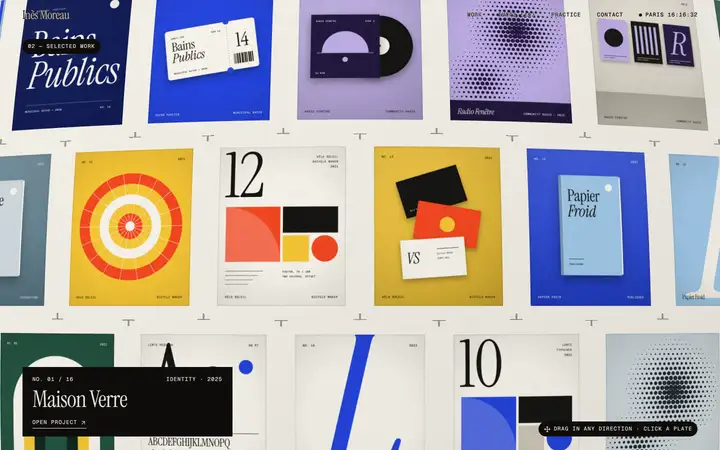
- `W`, the wall: seen from above, rotated −0.12 rad about x, at the distance where 3.5 units of height and 2.7 of width are always visible; κ = 0.08 (0.05 when tall).
- `I`, index: R = 14, α = 50°, limb on the left at NDC x = +0.14 (57 % of the width), the globe filling the right. When tall the globe leaves instead (limb at y = −1.9).
- `Iset`: the same, limb at x = +1.7: gone to the right.
- `N(rise)`, finale: like T, limb at y = 0.1 − 2(1 − rise) (−0.02 − 2(1 − rise) when tall): it rises with the page and stops 45 % from the top.
**Scroll ranges.** Seven values, 0..1, computed every frame from the scroll position y, the viewport height vh and the document offsets of the sections (`updateProgress` and `measure` in the reference code):
- `hero = y/heroEnd` (the pinned hero): the plane travels 5 rows toward the viewer; the globe turns under the statement.
- `toWall` (from the end of that pin to the top of the work stage): pose T→W, smoothstep.
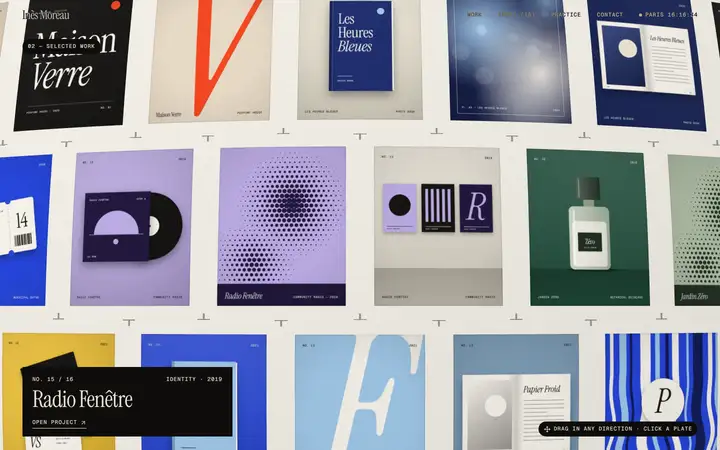
- `work` (the pinned wall): the wall pans 9 columns, linear.
- `toIndex` (the next 0.62 vh): pose→I, smoothstep. The theme goes from day to night over toIndex 0.05→0.6; on the globe night arrives as a terminator: night = smoothstep(−0.4, 0.4, theme×2.8 − 1.4 + N.x×0.9).
- `index` (while the index crosses the screen): offset y += 2.4×index.
- `set` (0.55 vh, from the moment practice is 0.62 vh below the top): pose→Iset. At set = 1 nothing is rendered until the finale.
- `rise` (the last vh of scroll): pose N(rise), linear; offset y += 3×rise.
**Pointer.** The ray under the pointer is intersected with the sphere and mapped back to the plane (`castAt`), which gives the plate under it (`cellAt`).
- Swell: plates near the pointer rise: w = strength×exp(−d²/1.7²), d = distance on the plane from plate centre to pointer; lift 0.012 + 0.42 w, scale 1 + 0.07 w.
- Drift: the pointer position (NDC, smoothed at 4/s) adds (0.9 x, 0.5 y) units to the offset and (−0.012 y, 0.02 x) rad to the rotation.
- Lens: the speed of the offset (units/s) adds min(0.05, speed×0.0045) to κ, rising at 9/s, relaxing at 2.5/s: fast drags, fast scrolls and the glides of the index bend the globe.
- Drag (mouse, touch): the grabbed point stays under the pointer; the offset follows its target at 14/s; on release the velocity, capped at 22 units/s, decays as exp(−3.2 t). A pointer down on a link, a button or `data-ui` never starts a drag.
- Click (under 7 px and 600 ms): emits the project and the cell. Cursor: `grab` over the globe, `pointer` over a plate, `grabbing` while dragging.
**Flight into a plate.** The plane slides so the clicked plate sits on the apex while `open` goes 0→1 in 1.0 s, `expo.inOut`: the pose blends to flat, facing the camera, κ = 0.02, at the distance where the plate is exactly as tall as the first plate of the project page, centred on that rectangle. The other plates scale to 0 during the first 55 % of the flight.
**Intro values.** `deal` 0→1 brings the plates in from the apex outward (scale smoothstep(deal×2.6 − 0.1×distance), falling from 0.9 above the paper); `intro` 0→1 blends T0→T while the globe turns by 5 units. The scene emits `ready` after its first eight frames.
#### Reference code
Use this code as written; adapt only imports and file layout to the project. Three files: shared state and scroll ranges; the scene (`<Globe atlas={canvas} />` receives the painted atlas); the fitting hook. The page drives the scene through `S` and four events: it calls `measure()` after layout and on resize; tweens `S.intro`, `S.deal`, `S.open`; before a flight sets `S.openCell` and `S.openRect` (the rectangle of the first plate of the project page) and calls `centreOn(cell)`; from the index sets `S.focus` and calls `glideTo(project)`; sets `S.paused` while the project page covers the canvas, and `S.reduced` under reduced motion. It listens to `ready` (intro), `hover` (tag), `centre` (caption), `pick` (open a project). The plate painter is yours to write from the atlas paragraph: `drawPlate(ctx, project, plate, x, y, width, accent)` and `paintAtlas(canvas, cell, accent)`, which paints eight plates, yields, and continues.
```ts
// state.ts: shared state, events, scroll ranges
/** One mutable object shared by the page (GSAP, DOM) and the scene (three.js), plus four events. */
export type Cell = { I: number; J: number };
export const S = {
reduced: false,
intro: 0, deal: 0, // intro, 0..1: the globe rises, the plates are dealt
p: { hero: 0, toWall: 0, work: 0, toIndex: 0, index: 0, set: 0, rise: 0 }, // scroll ranges, 0..1
theme: 0, // 0 day .. 1 night
m: { heroEnd: 1, workTop: 2, workEnd: 3, indexTop: 4, practiceTop: 5, contactTop: 6, vh: 1 }, // page offsets, px
mouse: { x: 0, y: 0, has: false }, // pointer in px; `has` once a mouse has moved
user: { x: 0, y: 0 }, userT: { x: 0, y: 0 }, fling: { x: 0, y: 0 }, follow: 12, // the visitor's offset of the plane, its target, its inertia
scroll: { x: 0, y: 0 }, // the scroll-driven offset of the plane, written by the scene
focus: -1, // project highlighted from the index (-1: none)
open: 0, openCell: null as Cell | null, openRect: { x: 0, y: 0, w: 1, h: 1 }, // flight into a plate: progress, cell, landing rectangle (px)
paused: false, // true while the project page covers the canvas
};
type Events = { hover: (project: number) => void; centre: (project: number, cell: Cell) => void; pick: (project: number, cell: Cell) => void; ready: () => void };
const handlers: { [K in keyof Events]: Set<Events[K]> } = { hover: new Set(), centre: new Set(), pick: new Set(), ready: new Set() };
export const on = <K extends keyof Events>(name: K, fn: Events[K]) => (handlers[name].add(fn), () => void handlers[name].delete(fn));
export const emit = <K extends keyof Events>(name: K, ...args: Parameters<Events[K]>) => handlers[name].forEach((fn) => (fn as (...a: unknown[]) => void)(...args));
const clamp01 = (v: number) => Math.min(1, Math.max(0, v));
/** Reads the page offsets the scroll ranges are built from. Call after layout and on every resize. */
export function measure() {
const el = (id: string) => document.getElementById(id), vh = window.innerHeight;
const top = (id: string) => (el(id) ? el(id)!.getBoundingClientRect().top + window.scrollY : 0);
S.m = { heroEnd: Math.max(1, (el("top")?.offsetHeight ?? vh) - vh), workTop: top("work"), workEnd: top("work") + (el("work")?.offsetHeight ?? vh) - vh, indexTop: top("index"), practiceTop: top("practice"), contactTop: top("contact"), vh };
}
/** Scroll position -> the progress of every range, and the theme. Called every frame. */
export function updateProgress() {
if (S.reduced) return;
const y = window.scrollY, { heroEnd, workTop, workEnd, indexTop, practiceTop, contactTop, vh } = S.m, p = S.p;
p.hero = clamp01(y / heroEnd); // pinned hero: the globe turns under the statement
p.toWall = clamp01((y - heroEnd) / Math.max(1, workTop - heroEnd)); // orbit from the horizon to straight above
p.work = clamp01((y - workTop) / Math.max(1, workEnd - workTop)); // pinned wall: it pans sideways
p.toIndex = clamp01((y - workEnd) / (0.62 * vh)); // orbit to the side, day turns to night
p.index = clamp01((y - (indexTop - vh)) / Math.max(1, practiceTop - indexTop + vh));
p.set = clamp01((y - (practiceTop - 0.62 * vh)) / (0.55 * vh)); // the globe leaves to the right
p.rise = clamp01((y - (contactTop - vh)) / vh); // and rises again with the last section
const t = clamp01((p.toIndex - 0.05) / 0.55);
S.theme = t * t * (3 - 2 * t);
}
```
```tsx
// Globe.tsx: the scene
/**
* The atlas: an endless plane of plates wrapped on a paper globe.
* One plane, three draw calls (ground, shadows, plates); every position is computed in the vertex shader.
*/
import * as THREE from "three";
import { Canvas, useFrame, useThree } from "@react-three/fiber";
import { useEffect, useMemo, useRef } from "react";
import { S, emit, updateProgress, type Cell } from "./state";
export const PX = 1.22, PY = 1.47; // pitch of the plates, plane units (a plate is 1 x 1.25)
const NC = 18, NR = 12; // instances: columns x rows, wrapped endlessly
const CAM_Z = 12;
const FLY = 5 * PY, PAN = 9 * PX; // travel of the plane during the two pinned ranges
const PLANE = /* glsl */ `
uniform vec2 uOffset; // where the plane has been dragged / scrolled to (plane units)
uniform float uKappa; // curvature of the globe, 1 / radius
uniform vec4 uPointer; // xy: the pointer on the plane, z: strength 0..1, w: radius
uniform float uDeal; // 0..1 intro: plates are dealt from the apex outward
uniform vec3 uOpen; // xy: cell of the opened plate, z: 0..1 (every other plate shrinks away)
const vec2 PITCH = vec2(1.22, 1.47);
const vec2 FIELD = vec2(18.0, 12.0);
// plane -> globe: azimuthal equidistant wrap around the apex (0, 0); n is the surface normal
vec3 globe(vec2 q, float lift, out vec3 n) {
float r = max(length(q), 1e-5), a = r * uKappa;
vec2 d = q / r;
n = vec3(d * sin(a), cos(a));
return vec3(d * sin(a), cos(a) - 1.0) / uKappa + n * lift;
}
// centre of this instance after wrapping, its endless cell (I, J) and its plate id (0..47)
vec2 tile(vec2 cell, out vec2 ij, out float id) {
vec2 span = FIELD * PITCH;
float ry = cell.y * PITCH.y - uOffset.y;
float wy = floor(ry / span.y + 0.5);
float J = cell.y - wy * FIELD.y;
float rx = cell.x * PITCH.x + mod(J, 2.0) * 0.5 * PITCH.x - uOffset.x; // odd rows are shifted half a pitch
float wx = floor(rx / span.x + 0.5);
float I = cell.x - wx * FIELD.x;
ij = vec2(I, J);
id = mod(I + 7.0 * J, 48.0);
return vec2(rx - wx * span.x, ry - wy * span.y);
}
// x: scale, y: lift above the paper, z: swell under the pointer (0..1)
vec3 stance(vec2 c, vec2 ij) {
vec2 d = c - uPointer.xy;
float w = uPointer.z * exp(-dot(d, d) / (uPointer.w * uPointer.w));
float t = clamp(uDeal * 2.6 - length(c) * 0.1, 0.0, 1.0);
t = t * t * (3.0 - 2.0 * t);
float keep = mix(1.0, step(abs(ij.x - uOpen.x) + abs(ij.y - uOpen.y), 0.5), uOpen.z);
return vec3(t * keep * (1.0 + 0.07 * w), 0.012 + 0.42 * w + (1.0 - t) * 0.9, w);
}
`;
const PAPER = /* glsl */ `
uniform vec3 uDay; uniform vec3 uNight; uniform vec3 uRimDay; uniform vec3 uRimNight;
uniform vec3 uKey; // key light direction (world)
uniform float uTheme; // 0 day .. 1 night; the terminator sweeps across the globe
vec3 paper(vec3 n, vec3 v, out float night) {
night = smoothstep(-0.4, 0.4, uTheme * 2.8 - 1.4 + n.x * 0.9);
float lit = 0.8 + 0.2 * smoothstep(-0.3, 0.9, dot(n, uKey));
vec3 col = mix(uDay, uNight, night) * lit;
float rim = pow(1.0 - max(dot(n, v), 0.0), 3.0);
return mix(col, mix(uRimDay, uRimNight, night), rim * 0.6);
}
`;
const GROUND_VERT = /* glsl */ `
${PLANE}
varying vec2 vQ; varying vec3 vN; varying vec3 vW;
void main() {
vec3 n; vec3 p = globe(position.xy, 0.0, n);
vec4 world = modelMatrix * vec4(p, 1.0);
vQ = position.xy; vN = mat3(modelMatrix) * n; vW = world.xyz;
gl_Position = projectionMatrix * viewMatrix * world;
}`;
const GROUND_FRAG = /* glsl */ `
${PAPER}
uniform vec2 uOffset; uniform vec4 uPointer; uniform vec3 uInk;
varying vec2 vQ; varying vec3 vN; varying vec3 vW;
const vec2 PITCH = vec2(1.22, 1.47);
void main() {
vec3 n = normalize(vN), v = normalize(cameraPosition - vW);
float night; vec3 col = paper(n, v, night);
// crop marks at the corners of every cell: they travel with the plates
vec2 c = vQ + uOffset;
float J = floor(c.y / PITCH.y + 0.5);
float lx = c.x - mod(J, 2.0) * 0.5 * PITCH.x;
vec2 l = vec2(mod(lx + 0.5 * PITCH.x, PITCH.x) - 0.5 * PITCH.x, c.y - J * PITCH.y);
vec2 e = 0.5 * PITCH - abs(l);
float aa = fwidth(c.x) + fwidth(c.y);
float mark = max((1.0 - smoothstep(0.003, 0.003 + aa, e.y)) * step(e.x, 0.05), (1.0 - smoothstep(0.003, 0.003 + aa, e.x)) * step(e.y, 0.05));
col = mix(col, mix(uInk, uRimNight * 1.6, night), mark * 0.42 * smoothstep(0.1, 0.5, dot(n, v)));
vec2 d = vQ - uPointer.xy;
col += uPointer.z * 0.035 * exp(-dot(d, d) / (uPointer.w * uPointer.w * 1.6));
col += (fract(sin(dot(gl_FragCoord.xy, vec2(12.9898, 78.233))) * 43758.5453) - 0.5) * 0.016;
gl_FragColor = vec4(col, 1.0);
}`;
const SHADOW_VERT = /* glsl */ `
${PLANE}
attribute vec2 aCell;
varying vec2 vP; varying float vSwell; varying float vScale;
void main() {
vec2 ij; float id; vec2 c = tile(aCell, ij, id);
vec3 st = stance(c, ij);
vec3 n; vec3 p = globe(c + position.xy * st.x + vec2(0.05, -0.07) * (1.0 + 7.0 * st.z), 0.005, n);
vP = position.xy; vSwell = st.z; vScale = st.x;
gl_Position = projectionMatrix * viewMatrix * modelMatrix * vec4(p, 1.0);
}`;
const SHADOW_FRAG = /* glsl */ `
uniform vec3 uInk; uniform float uTheme;
varying vec2 vP; varying float vSwell; varying float vScale;
void main() {
vec2 d = abs(vP) - vec2(0.5, 0.625);
float sd = length(max(d, 0.0)) + min(max(d.x, d.y), 0.0);
float blur = 0.06 + 0.2 * vSwell;
float a = (1.0 - smoothstep(-blur * 0.5, blur, sd)) * mix(0.34, 0.22, vSwell);
gl_FragColor = vec4(uInk, a * (1.0 - 0.75 * uTheme) * step(0.02, vScale));
}`;
const TILE_VERT = /* glsl */ `
${PLANE}
attribute vec2 aCell;
varying vec2 vUv; varying float vId; varying vec3 vN; varying vec3 vW; varying float vSwell;
void main() {
vec2 ij; float id; vec2 c = tile(aCell, ij, id);
vec3 st = stance(c, ij);
vec3 n; vec3 p = globe(c + position.xy * st.x, st.y, n);
vec4 world = modelMatrix * vec4(p, 1.0);
vUv = uv; vId = id; vN = mat3(modelMatrix) * n; vW = world.xyz; vSwell = st.z;
gl_Position = projectionMatrix * viewMatrix * world;
}`;
const TILE_FRAG = /* glsl */ `
${PAPER}
uniform sampler2D uAtlas; // 8 x 6 plates
uniform vec3 uBack; // raking light for the sheen
uniform vec2 uVel; // velocity of the plane: chromatic split
uniform vec2 uFocus; // x: project to keep, y: 0..1 dimming of the others
varying vec2 vUv; varying float vId; varying vec3 vN; varying vec3 vW; varying float vSwell;
vec3 plate(float id, vec2 st) {
st = clamp(st, 0.006, 0.994);
return texture2D(uAtlas, vec2(mod(id, 8.0) + st.x, 5.0 - floor(id / 8.0) + st.y) / vec2(8.0, 6.0)).rgb;
}
void main() {
float id = floor(vId + 0.5);
vec2 ca = uVel * 0.0011;
vec3 col = vec3(plate(id, vUv + ca).r, plate(id, vUv).g, plate(id, vUv - ca).b);
vec3 n = normalize(vN), v = normalize(cameraPosition - vW);
float night; vec3 pap = paper(n, v, night);
col *= 0.85 + 0.19 * smoothstep(-0.3, 0.9, dot(n, uKey));
col += pow(max(dot(reflect(-uBack, n), v), 0.0), 14.0) * 0.2 * (1.0 - 0.5 * night) + vSwell * 0.03;
float edge = min(min(vUv.x, 1.0 - vUv.x), min(vUv.y, 1.0 - vUv.y) * 1.25);
col *= 1.0 - 0.1 * (1.0 - smoothstep(0.0, 0.012, edge));
col = mix(col, pap, uFocus.y * step(0.5, abs(floor(id / 3.0) - uFocus.x)) * 0.84);
col = mix(col, pap, pow(1.0 - max(dot(n, v), 0.0), 2.5) * 0.7);
gl_FragColor = vec4(col, 1.0);
}`;
type Pose = { rx: number; ry: number; x: number; y: number; z: number; k: number };
const rad = (deg: number) => (deg * Math.PI) / 180;
const mix = (a: Pose, b: Pose, t: number): Pose => ({ rx: a.rx + (b.rx - a.rx) * t, ry: a.ry + (b.ry - a.ry) * t, x: a.x + (b.x - a.x) * t, y: a.y + (b.y - a.y) * t, z: a.z + (b.z - a.z) * t, k: a.k + (b.k - a.k) * t });
const io = (t: number) => t * t * (3 - 2 * t);
/**
* A globe of radius R seen so that it spans `alpha` degrees around its centre, with its limb (horizon) at `ndc`
* of the screen: at the top of the globe ("top", ndc is y) or on its left ("left", ndc is x).
* `gamma` is how far, in degrees toward the limb, the apex of the plane sits from the point under the camera.
*/
function limb(side: "top" | "left", R: number, alpha: number, ndc: number, gamma: number, th: number, aspect: number): Pose {
const a = rad(alpha), dc = R / Math.sin(a);
if (side === "top") {
const beta = a - Math.atan(ndc * th), psi = beta + rad(gamma);
return { rx: -psi, ry: 0, x: 0, y: -dc * Math.sin(beta) + R * Math.sin(psi), z: CAM_Z - dc * Math.cos(beta) + R * Math.cos(psi), k: 1 / R };
}
const beta = a + Math.atan(ndc * th * aspect), psi = beta + rad(gamma);
return { rx: 0, ry: -psi, x: dc * Math.sin(beta) - R * Math.sin(psi), y: 0, z: CAM_Z - dc * Math.cos(beta) + R * Math.cos(psi), k: 1 / R };
}
function buildPoses(aspect: number) {
const tall = aspect < 0.8, fov = tall ? 50 : 32, th = Math.tan(rad(fov / 2)), R = tall ? 21 : 15;
const d = Math.max(3.5 / (2 * th), 2.7 / (2 * th * aspect)); // the wall shows at least 3.5 units of height and 2.7 of width
const top = (ndc: number, r = R) => limb("top", r, 52, ndc, 25, th, aspect);
return {
fov, th,
T0: top(-1.25, R * 0.8), // intro: just below the screen
T: top(tall ? -0.1 : 0.12), // hero: the limb at 44 % of the height (55 % on a phone)
W: { rx: -0.12, ry: 0, x: 0, y: 0, z: CAM_Z - d, k: tall ? 0.05 : 0.08 } as Pose, // the wall, seen from above
I: tall ? top(-1.9) : limb("left", 14, 50, 0.14, 25, th, aspect), // index: the limb at 57 % of the width
Iset: tall ? top(-1.9) : limb("left", 14, 50, 1.7, 25, th, aspect), // set: gone to the right
// finale: the limb rises with the page, 45 % of a screen below the top of the contact section
N: (rise: number) => top((tall ? -0.02 : 0.1) - 2 * (1 - rise)),
};
}
const mod = (n: number, m: number) => ((n % m) + m) % m;
/** The plate at a point of the endless plane, or null between plates. */
export function cellAt(X: number, Y: number): (Cell & { id: number }) | null {
const J = Math.round(Y / PY), bx = mod(J, 2) * 0.5 * PX, I = Math.round((X - bx) / PX);
if (Math.abs(X - bx - I * PX) > 0.5 || Math.abs(Y - J * PY) > 0.625) return null;
return { I, J, id: mod(I + 7 * J, 48) };
}
/** Slides the plane so that a plate sits exactly on the apex (the flight into a plate starts with this). */
export function centreOn(cell: Cell) {
S.userT.x = cell.I * PX + mod(cell.J, 2) * 0.5 * PX - S.scroll.x; S.userT.y = cell.J * PY - S.scroll.y;
S.fling.x = S.fling.y = 0; S.follow = 7;
}
/** Slides the plane so the middle plate of a project sits on the apex (used by the index). */
export function glideTo(project: number) {
const want = project * 3 + 1, cx = S.user.x + S.scroll.x, cy = S.user.y + S.scroll.y, Jc = Math.round(cy / PY);
let best = { X: cx, Y: cy }, bd = Infinity;
for (let J = Jc - 24; J <= Jc + 24; J++) {
const bx = mod(J, 2) * 0.5 * PX, base = mod(want - 7 * J, 48);
const I = base + 48 * Math.round(((cx - bx) / PX - base) / 48);
const X = I * PX + bx, Y = J * PY, dist = Math.hypot(X - cx, Y - cy);
if (dist < bd) { bd = dist; best = { X, Y }; }
}
S.userT.x = best.X - S.scroll.x; S.userT.y = best.Y - S.scroll.y;
S.fling.x = S.fling.y = 0; S.follow = 4.5;
}
function Atlas({ atlas }: { atlas: HTMLCanvasElement }) {
const group = useRef<THREE.Group>(null!);
const { gl, scene, camera, size } = useThree();
const aspect = size.width / size.height;
const poses = useMemo(() => buildPoses(aspect), [aspect]);
const { U, ground, shadows, tiles, texture } = useMemo(() => {
const texture = new THREE.CanvasTexture(atlas);
texture.anisotropy = Math.min(8, gl.capabilities.getMaxAnisotropy());
const v3 = (hex: string) => { const c = new THREE.Color(); c.setStyle(hex, THREE.NoColorSpace); return new THREE.Vector3(c.r, c.g, c.b); };
const U = {
uOffset: { value: new THREE.Vector2() }, uKappa: { value: 1 / 15 }, uPointer: { value: new THREE.Vector4(0, 0, 0, 1.7) }, uDeal: { value: 0 }, uOpen: { value: new THREE.Vector3() },
uDay: { value: v3("#F4F0E8") }, uNight: { value: v3("#181613") }, uRimDay: { value: v3("#CDC6B6") }, uRimNight: { value: v3("#5E584D") }, uInk: { value: v3("#0E0D0B") },
uKey: { value: new THREE.Vector3(-0.45, 0.75, 0.5).normalize() }, uBack: { value: new THREE.Vector3(-0.17, 0.78, -0.6).normalize() },
uTheme: { value: 0 }, uAtlas: { value: texture }, uVel: { value: new THREE.Vector2() }, uFocus: { value: new THREE.Vector2(0, 0) },
};
const cells = new Float32Array(NC * NR * 2);
for (let j = 0, n = 0; j < NR; j++) for (let i = 0; i < NC; i++) { cells[n++] = i - NC / 2; cells[n++] = j - NR / 2; }
const instanced = (w: number, h: number, sx: number, sy: number) => {
const g = new THREE.InstancedBufferGeometry().copy(new THREE.PlaneGeometry(w, h, sx, sy) as unknown as THREE.InstancedBufferGeometry);
g.setAttribute("aCell", new THREE.InstancedBufferAttribute(cells, 2));
g.instanceCount = NC * NR;
return g;
};
const ground = new THREE.Mesh(new THREE.PlaneGeometry(46, 46, 84, 84), new THREE.ShaderMaterial({ uniforms: U, vertexShader: GROUND_VERT, fragmentShader: GROUND_FRAG }));
const shadows = new THREE.Mesh(instanced(1.6, 1.85, 1, 1), new THREE.ShaderMaterial({ uniforms: U, vertexShader: SHADOW_VERT, fragmentShader: SHADOW_FRAG, transparent: true, depthWrite: false }));
const tiles = new THREE.Mesh(instanced(1, 1.25, 4, 5), new THREE.ShaderMaterial({ uniforms: U, vertexShader: TILE_VERT, fragmentShader: TILE_FRAG }));
for (const m of [ground, shadows, tiles]) m.frustumCulled = false; // positions are computed in the shader
return { U, ground, shadows, tiles, texture };
}, [atlas, gl]);
const st = useRef({ inv: new THREE.Matrix4(), k: 1 / 15, ox: 0, oy: 0, px: 0, py: 0, first: true, vx: 0, vy: 0, bend: 0, parX: 0, parY: 0, swell: 0, focus: 0, hover: -1, centre: -1, cursor: "", frames: 0, cleared: false, rect: { left: 0, top: 0, width: 1, height: 1 } });
const drag = useRef<null | { id: number; x: number; y: number; t0: number; t: number; moved: number; gx: number; gy: number; vx: number; vy: number }>(null);
const tmp = useMemo(() => ({ o: new THREE.Vector3(), d: new THREE.Vector3() }), []);
/** pointer (px) -> point of the plane under it (apex at 0, 0), or null when the ray misses the globe */
const castAt = (px: number, py: number): [number, number] | null => {
const s = st.current, r = s.rect, th = poses.th;
const nx = ((px - r.left) / r.width) * 2 - 1, ny = 1 - ((py - r.top) / r.height) * 2;
const o = tmp.o.set(0, 0, CAM_Z).applyMatrix4(s.inv), d = tmp.d.set(nx * th * (r.width / r.height), ny * th, -1).transformDirection(s.inv);
const R = 1 / s.k, cz = o.z + R; // the globe is centred on (0, 0, -R)
const b = o.x * d.x + o.y * d.y + cz * d.z, disc = b * b - (o.x * o.x + o.y * o.y + cz * cz - R * R);
if (disc < 0) return null;
const t = -b - Math.sqrt(disc);
if (t < 0) return null;
const hx = (o.x + d.x * t) / R, hy = (o.y + d.y * t) / R, hz = (cz + d.z * t) / R, len = Math.hypot(hx, hy);
const arc = Math.acos(Math.min(1, Math.max(-1, hz))) * R;
return len < 1e-6 ? [0, 0] : [(hx / len) * arc, (hy / len) * arc];
};
useEffect(() => {
(camera as THREE.PerspectiveCamera).fov = poses.fov;
camera.updateProjectionMatrix();
st.current.frames = 0;
}, [camera, poses]);
useEffect(() => {
const s = st.current;
const isUi = (t: EventTarget | null) => t instanceof Element && !!t.closest("a,button,input,[data-ui]");
const live = () => !S.paused && S.open === 0 && !(S.p.set >= 1 && S.p.rise <= 0);
const down = (e: PointerEvent) => {
if (!live() || isUi(e.target) || (e.pointerType === "mouse" && e.button !== 0)) return;
const q = castAt(e.clientX, e.clientY);
if (!q) return;
const now = performance.now();
drag.current = { id: e.pointerId, x: e.clientX, y: e.clientY, t0: now, t: now, moved: 0, gx: q[0] + s.ox, gy: q[1] + s.oy, vx: 0, vy: 0 };
S.fling.x = S.fling.y = 0;
S.follow = 14;
if (e.pointerType === "mouse") e.preventDefault();
};
const move = (e: PointerEvent) => {
if (e.pointerType === "mouse") { S.mouse.x = e.clientX; S.mouse.y = e.clientY; S.mouse.has = !S.reduced; }
const d = drag.current;
if (!d || d.id !== e.pointerId || S.reduced) return;
d.moved += Math.abs(e.clientX - d.x) + Math.abs(e.clientY - d.y);
const q = castAt(e.clientX, e.clientY), now = performance.now(), dt = Math.max(8, now - d.t) / 1000;
// keep the grabbed point of the plane under the pointer; off the globe, fall back to the screen delta
let dx = q ? d.gx - q[0] - s.ox : -(e.clientX - d.x) * 0.006, dy = q ? d.gy - q[1] - s.oy : (e.clientY - d.y) * 0.012;
const len = Math.hypot(dx, dy);
if (len > 1.6) { dx *= 1.6 / len; dy *= 1.6 / len; }
const tx = S.user.x + dx, ty = S.user.y + dy;
d.vx += ((tx - S.userT.x) / dt - d.vx) * 0.5; d.vy += ((ty - S.userT.y) / dt - d.vy) * 0.5;
S.userT.x = tx; S.userT.y = ty;
d.x = e.clientX; d.y = e.clientY; d.t = now;
};
const up = (e: PointerEvent) => {
const d = drag.current;
if (!d || d.id !== e.pointerId) return;
drag.current = null;
S.follow = 12;
if (d.moved < 7 && performance.now() - d.t0 < 600) {
const q = castAt(e.clientX, e.clientY), cell = q && cellAt(q[0] + s.ox, q[1] + s.oy);
S.userT.x = S.user.x; S.userT.y = S.user.y;
if (cell) emit("pick", Math.floor(cell.id / 3), cell);
} else if (performance.now() - d.t < 120) {
const cl = (v: number) => Math.max(-22, Math.min(22, v));
S.fling.x = cl(d.vx); S.fling.y = cl(d.vy);
}
};
const cancel = () => { drag.current = null; };
const leave = () => { S.mouse.has = false; };
const listen = [["pointerdown", down], ["pointermove", move], ["pointerup", up], ["pointercancel", cancel]] as const;
listen.forEach(([name, fn]) => window.addEventListener(name, fn as EventListener));
document.documentElement.addEventListener("mouseleave", leave);
return () => {
listen.forEach(([name, fn]) => window.removeEventListener(name, fn as EventListener));
document.documentElement.removeEventListener("mouseleave", leave);
};
// eslint-disable-next-line react-hooks/exhaustive-deps
}, [poses]);
useFrame((_, raw) => {
const dt = Math.min(Math.max(raw, 1e-3), 0.1), s = st.current, P = S.p, g = group.current;
updateProgress();
const hidden = S.paused || (P.set >= 1 && P.rise <= 0);
const r = gl.domElement.getBoundingClientRect();
s.rect = { left: r.left, top: r.top, width: r.width || 1, height: r.height || 1 };
// ---- the plane's offset: scroll + the user's drag and inertia + a drift that follows the pointer
S.scroll.x = PAN * P.work;
S.scroll.y = FLY * P.hero + 2.4 * P.index + 3 * P.rise - (1 - S.intro) * 5;
if (!drag.current) {
const f = Math.exp(-3.2 * dt);
S.userT.x += S.fling.x * dt; S.userT.y += S.fling.y * dt;
S.fling.x *= f; S.fling.y *= f;
}
const fol = 1 - Math.exp(-S.follow * dt);
S.user.x += (S.userT.x - S.user.x) * fol; S.user.y += (S.userT.y - S.user.y) * fol;
const mx = S.mouse.has ? ((S.mouse.x - s.rect.left) / s.rect.width) * 2 - 1 : 0, my = S.mouse.has ? 1 - ((S.mouse.y - s.rect.top) / s.rect.height) * 2 : 0;
const pf = 1 - Math.exp(-4 * dt), calm = 1 - S.open;
s.parX += (mx - s.parX) * pf; s.parY += (my - s.parY) * pf;
const ox = S.user.x + S.scroll.x + s.parX * 0.9 * calm, oy = S.user.y + S.scroll.y + s.parY * 0.5 * calm;
// ---- speed bends the plane like a lens
if (s.first) { s.px = ox; s.py = oy; s.first = false; }
const vf = 1 - Math.exp(-10 * dt);
s.vx += ((ox - s.px) / dt - s.vx) * vf; s.vy += ((oy - s.py) / dt - s.vy) * vf;
s.px = ox; s.py = oy;
const speed = Math.hypot(s.vx, s.vy), want = Math.min(0.05, speed * 0.0045);
s.bend += (want - s.bend) * (1 - Math.exp(-(want > s.bend ? 9 : 2.5) * dt));
// ---- the pose: where the globe is seen from, by scroll range
let pose = mix(poses.T0, poses.T, S.intro);
if (P.toWall > 0) pose = mix(pose, poses.W, io(P.toWall));
if (P.toIndex > 0) pose = mix(pose, poses.I, io(P.toIndex));
if (P.set > 0) pose = mix(pose, poses.Iset, io(P.set));
if (P.rise > 0) pose = poses.N(P.rise);
if (S.open > 0) {
// flight into a plate: it lands, flat and facing the camera, exactly on the rectangle of the project page
const q = S.openRect, d = 1.25 / (2 * poses.th * (q.h / s.rect.height));
const nx = ((q.x + q.w / 2) / s.rect.width) * 2 - 1, ny = 1 - ((q.y + q.h / 2) / s.rect.height) * 2;
pose = mix(pose, { rx: 0, ry: 0, x: nx * d * poses.th * aspect, y: ny * d * poses.th, z: CAM_Z - d, k: 0.02 }, S.open);
}
s.k = pose.k + s.bend * calm;
g.position.set(pose.x, pose.y, pose.z);
g.rotation.set(pose.rx - s.parY * 0.012 * calm, pose.ry + s.parX * 0.02 * calm, 0);
g.updateMatrixWorld();
s.inv.copy(g.matrixWorld).invert();
s.ox = ox; s.oy = oy;
// ---- what the pointer is over
const q = S.mouse.has && S.open === 0 && !hidden ? castAt(S.mouse.x, S.mouse.y) : null;
let hover = -1;
if (q) {
U.uPointer.value.x = q[0]; U.uPointer.value.y = q[1];
const cell = cellAt(q[0] + ox, q[1] + oy);
if (cell) hover = Math.floor(cell.id / 3);
}
s.swell += ((q ? 1 : 0) - s.swell) * (1 - Math.exp(-6 * dt));
U.uPointer.value.z = s.swell * calm;
if (hover !== s.hover) { s.hover = hover; emit("hover", hover); }
const cursor = drag.current ? "grabbing" : hover >= 0 ? "pointer" : q ? "grab" : "";
if (cursor !== s.cursor) { s.cursor = cursor; document.body.style.cursor = cursor; }
if (P.toWall > 0.5 && P.toIndex < 0.5) {
const mid = castAt(s.rect.left + s.rect.width / 2, s.rect.top + s.rect.height / 2);
const cell = mid && cellAt(mid[0] + ox, mid[1] + oy);
if (cell && cell.id !== s.centre) { s.centre = cell.id; emit("centre", Math.floor(cell.id / 3), cell); }
}
// ---- uniforms
const wx = 48 * PX, wy = 48 * PY; // the plates repeat every 48 cells: keep the numbers small
U.uOffset.value.set(mod(ox, wx), mod(oy, wy));
U.uKappa.value = s.k;
U.uDeal.value = S.deal;
U.uTheme.value = S.theme;
const vl = Math.min(1, 14 / Math.max(speed, 1e-3));
U.uVel.value.set(s.vx * vl, s.vy * vl);
s.focus += ((S.focus >= 0 ? 1 : 0) - s.focus) * (1 - Math.exp(-8 * dt));
if (S.focus >= 0) U.uFocus.value.x = S.focus;
U.uFocus.value.y = s.focus;
if (S.openCell) U.uOpen.value.set(S.openCell.I - 48 * Math.floor(ox / wx), S.openCell.J - 48 * Math.floor(oy / wy), Math.min(1, S.open * 1.8));
else U.uOpen.value.z = 0;
// ---- render only while the globe can be seen (reduced motion: a still frame)
const still = S.reduced && s.frames > 3;
if ((!hidden && !still) || (hidden && !s.cleared)) {
gl.render(scene, camera);
s.cleared = hidden;
if (s.frames++ === 8) emit("ready"); // the intro starts once the first frames are out
}
}, 1);
return <group ref={group}><primitive object={ground} /><primitive object={shadows} /><primitive object={tiles} /></group>;
}
export default function Globe({ atlas }: { atlas: HTMLCanvasElement }) {
const created = ({ gl }: { gl: THREE.WebGLRenderer }) => {
gl.setClearColor(0x000000, 0);
};
return (
<Canvas dpr={[1, 1.75]} flat gl={{ antialias: true, alpha: true, powerPreference: "high-performance" }} camera={{ fov: 32, position: [0, 0, CAM_Z], near: 0.1, far: 120 }} style={{ pointerEvents: "none" }} onCreated={created}>
<Atlas atlas={atlas} />
</Canvas>
);
}
```
```ts
// useFitText.ts
import { useLayoutEffect, type RefObject } from "react";
/** Fits one line of type to the exact width of its parent, whatever the words are. The element is an inline-block with white-space: nowrap (or pre). */
export function useFitText(ref: RefObject<HTMLElement | null>, deps: unknown[] = [], options: { min?: number; max?: number } = {}) {
const { min = 12, max = 2000 } = options;
useLayoutEffect(() => {
const el = ref.current;
const parent = el?.parentElement;
if (!el || !parent) return;
const fit = () => {
el.style.fontSize = "100px";
const natural = el.getBoundingClientRect().width; // width of the line at 100px
if (!natural) return;
el.style.fontSize = `${Math.max(min, Math.min(max, (100 * parent.clientWidth) / natural))}px`;
};
fit();
const observer = new ResizeObserver(fit);
observer.observe(parent);
document.fonts?.ready.then(fit);
return () => observer.disconnect();
}, deps);
}
```
### 5.2 Navigation
Fixed, top, 60 px high, `z-index: 30`, padding-inline = margin, text `#E6E0D3` with `mix-blend-mode: difference` (ink on bone, bone on night, legible over plates). Pointer events off except on links.
- Left: a link to `#top`, a slot 1.75rem high that clips its content and takes the free width. It stacks the role (label) and the name (serif 1.5rem, not uppercase, ellipsis if too long). At the top of the page the role shows; past 30 % of a screen of scroll it slides up (yPercent −110) and the name comes up (yPercent 110→0), 0.7 s, `expo.out`; reversed on the way back.
- Right, gap `clamp(14px, 2.2vw, 34px)`: links Work (`#work`), Index (16) (`#index`), Practice (`#practice`), Contact (`#contact`), then the clock: a 6 px dot and `Paris 14:32:07`, refreshed every second with `Intl.DateTimeFormat` in the `Europe/Paris` time zone, 24 hours.
- Link hover and focus: a 1 px underline grows from the left (scaleX 0→1, 0.5 s, expo), leaves to the right. Anchors scroll smoothly (lenis `anchors: true`).
### 5.3 Hero: the atlas (`id="top"`, stage of 200vh)
Layer under the canvas:
- `h1`, the name: padding-top `clamp(62px, 9.4vh, 94px)`, margin-inline = margin; a mask (`display: block; overflow: clip; padding-bottom: 0.13em; margin-bottom: -0.1em`) holds an inline-block span, `white-space: pre`, whose font size is fitted to the mask width (`useFitText`), capped at 34 % of the viewport height. Under 640 px a name longer than 7 characters breaks at its first space into two lines, capped at 19 %.
- Under the name, a 12-column row, margin-top `clamp(10px, 2.2vh, 24px)`: the lede on columns 1 to 4; on columns 10 to 12, right-aligned, three label lines (projects, plates, years).
Layer over the canvas: two ink pills in the bottom corners, `clamp(18px, 3vh, 30px)` from the bottom: "Drag the atlas" (Move icon) left, "Scroll" (down arrow) right. A pill: label, padding 0.72em 1em, radius 999px, ink background, bone text, 13 px icon, gap 0.6em.
The globe is in pose T: about 35 plates show.
### 5.4 Approach (pinned with the hero)
In the layer under the canvas, absolutely positioned (top `clamp(70px, 10.4vh, 104px)`, sides = margin), invisible at load: a label "01 — Approach", then the statement in serif at the statement size, margin-top 0.32em, max-width 17.5em, "only thing left" in italics. It replaces the name while the hero is pinned.
### 5.5 Selected work: the wall (`id="work"`, stage of 200vh)
One layer over the canvas; its content box is inset 78 px from the top, the margin on the sides, `clamp(18px, 3vh, 30px)` from the bottom: a column with space between.
- Top left: an `h2` styled as a pill, "02 — Selected work".
- Bottom left: the caption card, marked `data-ui`: ink background, bone text, width `min(100%, 420px)`, padding 18px 20px 16px. Two labels with space between (`No. 13 / 16`, `Editorial · 2021`); the project title in serif (caption size, margin 10px 0 12px) in a clip, re-entering from below each time it changes (yPercent 105→0, 0.7 s, `expo.out`); a text button "Open project" with an up-right arrow (label, 1 px underline; hover: accent, arrow 3 px up and right).
- Bottom right: a pill, "Drag in any direction · click a plate", with the Move icon.
The card names the project whose plate is at the centre of the screen (the scene emits `centre`); "Open project" flies into that plate. Pose W: a curved wall, about five plates across.
### 5.6 Index (`id="index"`, night)
12 columns; content on columns 1 to 7. The night side of the globe fills the right five, its limb a vertical arc at 57 % of the width.
- Label "03 — Index" (muted); `h2`, "forty-eight" in italics; a header row of muted labels: No., Project, Discipline, Year.
- 16 rows, each a full-width button: grid `2.6rem minmax(0, 1fr) 9.5rem 3.2rem 1rem`, column gap = gutter, baseline-aligned, padding 0.56rem 0 0.5rem, hairline on top (and one under the list): number, title (serif, row size), discipline, year (muted labels), a 14 px up-right arrow.
- Hover and focus: the title slides 18 px right (0.6 s, expo); a 7 px accent dot scales in before it (0.45 s); the arrow comes in from the lower left (0.5 s); the other rows drop to 40 % opacity (0.35 s).
- They also drive the scene: the globe slides the middle plate of that project to its apex (nearest occurrence, follow 4.5/s) and the plates of all other projects fade 84 % toward the paper. Leaving the list restores them. A click opens the project page, without a flight.
### 5.7 Practice (`id="practice"`, night)
- Head, 12 columns, bottom-aligned: label "04 — Practice" across; `h2` on columns 1 to 7, "one desk." in italics; a lede on columns 9 to 12.
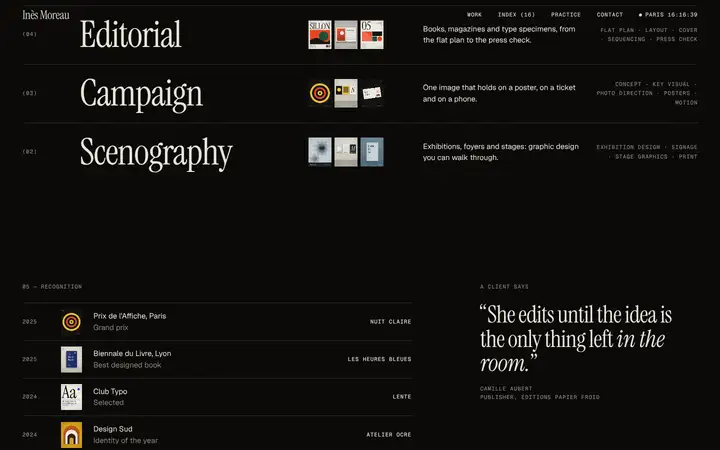
- Four rows inside the margins, margin-top `clamp(34px, 7vh, 72px)`. A row: 12-column grid (gap 10px by the gutter), vertically centred, padding `clamp(16px, 2.6vh, 26px)` 0, a 1 px rule on top, `isolation: isolate`: count (muted label), column 1; name (`h3`, practice size), columns 2 to 5; a strip of the three plates of one project, columns 6 and 7 (canvases `clamp(34px, 3.2vw, 46px)` wide, gap 6px); text, columns 8 to 10; services (muted labels, right-aligned, line-height 1.7), columns 11 and 12. The strips show projects 1, 5, 3, 11.
- Hover: a wash (`#E9E4D8`, `mix-blend-mode: difference`, half a margin wider than the row on each side) scales up from the bottom edge (scaleY 0→1, 0.55 s, expo): the row turns to ink on bone. The strip sits above the wash and fans out: `translate(-7px, -3px) rotate(-7deg)`, `translateY(-8px) scale(1.12)`, `translate(7px, -3px) rotate(7deg)`, 0.6 s, expo.
### 5.8 Recognition (`id="recognition"`, night, no bottom padding)
- Left, columns 1 to 7: label "05 — Recognition"; 22 px lower, six award rows: grid `3.4rem 2.6rem minmax(0, 1.2fr) minmax(0, 1fr)`, vertically centred, padding 0.7rem 0, hairlines: year (muted label); a thumbnail of the project's first plate (2.6rem wide; hover: scale 1.9, rotate −4° from its left edge, 0.6 s, expo); prize with its rank underneath in muted; project name as a right-aligned label.
- Right, columns 9 to 12: label "A client says"; the quote in serif at the quote size, "in the room." in italics; name and role as muted labels.
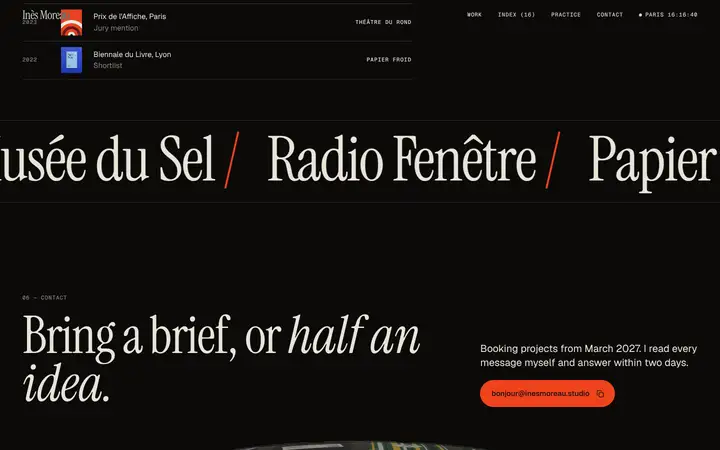
- Below, full bleed, margin-top `clamp(48px, 9vh, 96px)`: the clients line, one row in serif at the clients size between two hairlines: the eight names twice, each followed by an accent slash, gap 0.45em, overflow clipped; the scroll moves it sideways.
### 5.9 Contact and footer (the finale)
A wrapper: `min-height: 100vh`, flex column with space between, margin-top `clamp(40px, 8vh, 80px)`, no background: the globe shows between its two children.
- Contact (`id="contact"`, padding-top `clamp(84px, 12.5vh, 124px)`, 12 columns, row gap 20px): label "06 — Contact"; `h2` on columns 1 to 8 at the contact size, "half an idea." in italics; on columns 9 to 12, bottom-aligned, a lede and, 20 px lower, the main button: accent background, ink text, Geist 500, padding 1.05em 1.5em, radius 999px, with the e-mail address and a 15 px copy icon. A click copies the address and shows "Copied to the clipboard" with a check for 1.8 s. Hover: scale 1.04, 0.6 s, expo.
- Footer: background `var(--bg)`, hairline on top, padding 18px margin 22px. A row of labels with space between: `© 2026 Inès Moreau`, then muted: the address line, the live clock, the colophon. Then a bottom-aligned row: the name in serif, fitted to the free width, capped at 30 % of the viewport height (set like the hero name, in a clip), and a column of right-aligned label links, gap 9px: Instagram, Are.na, LinkedIn, "Back to the top ↑" (`#top`), underlined; on hover the underline retracts to the right (0.5 s, expo).
At the last scroll position: headline and button (top 40 %), the dome of the globe at night, the footer (bottom third).
### 5.10 Project page (in-page dialog)
`role="dialog"`, `aria-modal="true"`, labelled by the project title, marked `data-ui` and `data-lenis-prevent`; `position: fixed; inset: 0; z-index: 60`; bone background, ink text (always the day colours); its own scroll (`overflow-y: auto; overscroll-behavior: contain`).
- A sticky bar, 60 px, on bone: a button "Back to the atlas" with a left arrow; `No. 13 / 16`, muted, in the centre; "Next project" with a right arrow. Labels; hover: accent, the arrow moves 4 px outward.
- First block, 12 columns, vertically centred, `min-height: calc(100vh - 60px)`: the first plate on columns 1 to 5, width `min(100%, calc((100vh - 130px) * 0.8))`, painted at 960×1200; on columns 7 to 12: a muted label (`Editorial · Publisher · 2021`), the title (`h2`, project size), the lede, a definition list (5.5rem and 1fr, hairline above, max-width 30rem): Client, Scope, Role.
- The two other plates side by side, six columns each, with muted captions (`Plate 13.2 — Initial`).
- A full-width button, hairline on top: a muted label `Next — No. 14` and the next title in serif, sliding 18 px left on hover (0.6 s, expo).
- Keys: Escape closes; left and right arrows change project. On opening, focus goes to the back button.
### 5.11 Pointer tag and loader
- Tag: `position: fixed; z-index: 40`, no pointer events: a pill (background `var(--fg)`, text `var(--bg)`, label style) with a 6 px accent dot, `13 — Papier Froid`, then `Editorial · 2021` at 60 % opacity. It follows the pointer at (+18, +20) px, closing 25 % of the distance each frame, and fades in 0.25 s while a plate is under the pointer.
- Loader: a label fixed at the centre of the screen; its number counts up.
## 6. Motion
Everything that changes with time or scroll is driven from script (GSAP, the frame loop of the scene); CSS transitions are for hover states only.
Smooth scroll: lenis, `lerp: 0.11`, driven by `gsap.ticker`, `gsap.ticker.lagSmoothing(0)`. In the same tick, every frame: `ScrollTrigger.update()`, the scroll ranges of 5.1, the theme.
Intro. It starts 0.6 s after load, or at `ready` if that is later, never later than 1.0 s, and lasts 2.0 s. Until then navigation, name, lede and pills are hidden. From load the loader counts 00→48 in 0.6 s (`power1.in`). Then, at t =
- 0: the loader leaves (opacity 0, y −12, 0.35 s, `power2.in`); `intro` 0→1, 1.9 s, `power3.out` (the globe rises from under the screen, turning and settling); `deal` 0→1, 1.3 s, `power1.out`.
- 0.2: the name rises through its mask, yPercent 112→0, 1.3 s, `power4.out`.
- 0.8: navigation items, opacity 0→1 and y −10→0, 0.7 s, `power3.out`, stagger 0.06.
- 0.95: lede, counts, pills: opacity 0→1 and y 14→0, 0.7 s, `power3.out`, stagger 0.07.
Scroll moment 1, the pinned hero. One ScrollTrigger on the hero stage, start "top top", end "bottom bottom", `scrub: true`; a timeline of length 1, ease `none` unless stated:
- 0.02→0.22: the name leaves upward through its mask (yPercent 0→−116, `power2.in`). 0.02→0.14: lede, counts and pills fade (y −12, stagger 0.015).
- 0.19→0.24: the statement block appears; its label moves y 14→0 (`power2.out`).
- 0.24→0.87: the statement is split into words (SplitText); each goes from opacity 0.13 to 1 in 0.09, stagger 0.036.
Scroll moment 2, the orbit and the wall: between the pins the view goes from the horizon to straight above (the globe swallows the sky); then the work stage is pinned for 100vh and the wall pans nine columns.
Scroll moment 3, day to night: over `toIndex` 0.05→0.6 the three root colours are interpolated in RGB, in script, while the terminator sweeps the globe.
Scroll moment 4, the clients line: xPercent 2→−42, scrubbed from "top bottom" to "bottom top" of the recognition section. Scroll moment 5, the finale: the globe rises with the page (`rise`) and the footer name rises through its clip, yPercent 70→0, scrubbed from "top bottom" to "bottom bottom" of the footer.
Reveals, once. Titles and the quote, when their top passes 90 % of the viewport: split in lines with SplitText (`mask: "lines"`, `autoSplit: true`; masks get 0.14em of padding below and the same negative margin), each line from yPercent 110, 0.95 s, `expo.out`, stagger 0.09. Ledes and the awards list, at 92 %: opacity 0 and y 26→0, 0.9 s, `power3.out`. Index rows, at 92 %: y 26→0, 0.8 s, `power3.out`, stagger 0.03, the list fading in 0.6 s. Practice, at 88 %: the rules draw from the left (scaleX 0→1, 1.1 s, `expo.out`, stagger 0.1), the names come up (yPercent 50, opacity 0, 0.9 s, `expo.out`, stagger 0.1).
Project page.
- From a plate: lenis stops; the flight takes 1.0 s. At 0.76 s the page fades in (0.35 s, `power2.out`) around its first plate, which sits exactly where the flown plate landed; its texts follow 0.1 s later (opacity 0 and y 22→0, 0.8 s, `expo.out`, stagger 0.07). Then the scene stops rendering. From the index: the same fade, no flight.
- Next and previous: the page returns to its top; plates and texts fade in again (y 18→0, 0.6 s, `power3.out`, stagger 0.05).
- Close: the page fades out in 0.3 s (`power2.in`) while the plate flies back (`open` 1→0, 0.9 s, `expo.inOut`); lenis restarts. After a change of project there is no flight back.
Reduced motion (`prefers-reduced-motion: reduce`). No lenis, intro, scrubbed timeline or pin: the hero stage is 100vh, nothing is hidden at load. The canvas is absolutely positioned in the first screen and shows a still frame of pose T (four frames, then it stops): no swell, drift or drag; a click on a plate still opens its project. The statement is an ordinary section under the hero; the grid of section 8 replaces the work stage; the sections from the index down carry the night colours on their own backgrounds; the navigation shows the name; the project page opens with the fade only.
## 7. Responsive behaviour
- Under 768 px. Navigation: role or name, Index (16), Contact. Hero: the name on two lines, lede on columns 1 to 7, counts on 8 to 12; field of view 50°, R = 21, limb at 55 % of the height, two plates across the bottom. Work: the wall shows 2.7 units of width (two plates); the caption card is full width, the pill under it. Index: rows are `2rem minmax(0, 1fr) 3rem` (no discipline, arrow or dot); the globe is not shown: it leaves during `toIndex` and comes back for the finale. Practice rows stack: count and name, strip, text, services. Awards: `2.4rem 2.2rem minmax(0, 1fr)`, project label under the prize. Contact: one column. Footer: links in a row above the name. Project page: one column, first plate `min(100%, 60vh)` wide. Fallback grid: two columns.
- Touch: a horizontal drag pans the globe, a vertical one scrolls the page; a tap on a plate opens it. No pointer tag, no swell.
- No horizontal overflow from 360 to 1440 px. A name of 3 to 24 characters never breaks the layout: hero and footer names are fitted.
## 8. Accessibility and performance
- Semantics: one `h1` (the name), an `h2` per section, `h3` for practice names. Index rows are buttons with a full label ("Open Papier Froid, Editorial, 2021"). The WebGL canvas is `aria-hidden`; plate canvases in the DOM have `role="img"` and a label; the caption card is `aria-live="polite"`. Every project is reachable by keyboard through the index.
- Contrast: ink on bone and bone on night above 14:1; muted text at least 4.6:1. A visible focus ring everywhere.
- Budgets, as requirements: `dpr` 1 to 1.75; one WebGL canvas for the page; 3 draw calls and about 23,000 triangles (ceilings: 150 and 300,000); plates and shadows instanced; no post-processing, no noise loop in a fragment shader, no raymarching. DOM animation on transform and opacity only, except the three theme colours on the root. No `filter: blur()`, no `backdrop-filter`. About 8.5 screens at 1440×900 (ceiling: 10).
- Rendering stops when the globe is out of sight (between index and finale), under the project page, and in a hidden tab. The atlas is painted after the fonts are loaded, eight plates at a time, yielding in between.
- Without WebGL (no `webgl2` context): no canvas, never a blank area. The first screen keeps its type and pinned statement and shows a CSS stand-in for the globe: one 2D canvas of 11×5 plates (150 px wide, gap 34 px, odd rows shifted, flat shadows, on paper) in a box that starts 44 % from the top with `perspective: 1100px; perspective-origin: 50% 0`; the canvas is `max(150vw, 1500px)` wide, tilted `rotateX(58deg)` from its bottom edge, clipped with `ellipse(50% 100% at 50% 100%)`: its far edge is a dome. The work stage becomes an ordinary section: its label, a title (copy deck) and a grid of 16 cards (4 columns): the first plate of each project, a label line (number, title, year); a card lifts 6 px on hover and opens the project page. The same grid replaces the wall under reduced motion.
## 9. Copy deck
Brand: [BRAND] :: Inès Moreau; [ROLE] :: Art director — Paris; [CITY] :: Paris; [TIMEZONE] :: Europe/Paris; [EMAIL] :: bonjour@inesmoreau.studio (the brand in lower case without accents or spaces, between "bonjour@" and ".studio"); [ACCENT] :: #F0421C
Document title: [BRAND] — Art director, Paris. Description: [BRAND], art director in Paris: an atlas of sixteen projects for brands, books and stages.
Navigation: [ROLE]; [BRAND]; Work; Index (16); Practice; Contact; [CITY] 14:32:07
Loader: Laying out 00 / 48 plates
Hero: [BRAND]; [LEDE] :: Art direction for brands, books and stages. Independent, in Paris, since 2014.; (16) projects; (48) plates; 2018 — 2026; Drag the atlas; Scroll
Approach: 01 — Approach; [STATEMENT] :: I arrange type, image and space until the idea is the *only thing left* on the page.
Selected work: 02 — Selected work; No. 13 / 16; Open project; Drag in any direction · click a plate
Index: 03 — Index; Sixteen projects, *forty-eight* plates.; No.; Project; Discipline; Year
Practice: 04 — Practice; Four disciplines, *one desk.*; I work alone, or with a small crew of photographers, type designers and builders chosen for the project. No account managers: you talk to the person who draws.
Practice rows (count; name; text; services, joined with " · " on the page): (07); Identity; Names, marks, type systems and packaging, with the rules that keep them alive after launch.; Naming, Wordmark, Type system, Packaging, Guidelines // (04); Editorial; Books, magazines and type specimens, from the flat plan to the press check.; Flat plan, Layout, Cover, Sequencing, Press check // (03); Campaign; One image that holds on a poster, on a ticket and on a phone.; Concept, Key visual, Photo direction, Posters, Motion // (02); Scenography; Exhibitions, foyers and stages: graphic design you can walk through.; Exhibition design, Signage, Stage graphics, Print
Recognition: 05 — Recognition; A client says; “She edits until the idea is the only thing left *in the room.*”; Camille Aubert; Publisher, Éditions Papier Froid
Awards (year; prize; rank; project): 2025; Prix de l'Affiche, Paris; Grand prix; Nuit Claire // 2025; Biennale du Livre, Lyon; Best designed book; Les Heures Bleues // 2024; Club Typo; Selected; Lente // 2024; Design Sud; Identity of the year; Atelier Ocre // 2023; Prix de l'Affiche, Paris; Jury mention; Théâtre du Rond // 2022; Biennale du Livre, Lyon; Shortlist; Papier Froid
Clients line: Maison Verre / Opéra de Minuit / Halle Nord / Revue Sillon / Café Lundi / Musée du Sel / Radio Fenêtre / Papier Froid /
Contact: 06 — Contact; Bring a brief, or *half an idea.*; Booking projects from March 2027. I read every message myself and answer within two days.; [EMAIL]; Copied to the clipboard
Footer: © 2026 [BRAND]; Paris 11e — by appointment; [CITY] 14:32:07; Set in Instrument Serif and Geist; Instagram; Are.na; LinkedIn; Back to the top ↑
Project page: Back to the atlas; No. 13 / 16; Next project; Client; Scope; Role; Art direction, design; Plate 13.2 — Initial; Next — No. 14
Plate names (captions and labels), in the order of the templates: The bottle; Wordmark; Initial; The book; Key image; Spread; Key visual; Poster series; Ticket; The mark; Stationery; Cover; Specimen; Pattern; Packaging; Halftone study; Record sleeve; Poster
Without WebGL and with reduced motion: 02 — Selected work; Sixteen projects, laid *flat.*
Projects: number; title; discipline; kind; year; client; scope (joined with " · " on the page); colours g k p s ("A" = accent); the three plates; lede.
01; Maison Verre; Identity; Perfume house; 2025; Maison Verre, Grasse; Wordmark, Bottle, Launch poster; #E4D6C2 #11100E A #C8B595; bottle wordmark letter; A perfume house that releases one scent a year. The identity is a single serif cut like glass, and a bottle whose label is small enough to be read only up close.
02; Les Heures Bleues; Editorial; Photo book; 2025; Éditions Papier Froid; Book design, Sequencing, Cover; #1B2A6B #0C1233 #9CC4E4 #E9E2D0; book photo spread; Sixty photographs taken between dusk and night. The sequence follows the light going down: the pages darken until the last one is almost ink.
03; Nuit Claire; Campaign; Music festival; 2024; Festival Nuit Claire, Arles; Key visual, Poster series, Tickets; #11100E #F3EFE6 #F2C230 A; rings posters ticket; One yellow disc that never sets. On the posters it is a sun, on the tickets a punched hole, on stage a lamp six metres wide.
04; Atelier Ocre; Identity; Ceramics studio; 2024; Atelier Ocre, Marseille; Mark, Stationery, Signage; #D9A21B #2A1B0A #F3EFE6 #B5541D; arches cards wordmark; The arch of the kiln door became the mark, the pattern and the shelf labels. Everything is printed in the one ochre the studio fires.
05; Revue Sillon; Editorial; Quarterly magazine; 2024; Revue Sillon; Redesign, Masthead, Templates; #F3EFE6 #11100E A #1E4D3A; magazine spread grid; A farming and food quarterly rebuilt around one rule: the photograph gets the page, the words get the margin.
06; Théâtre du Rond; Scenography; Theatre season; 2023; Théâtre du Rond, Lyon; Season identity, Foyer, Posters; A #11100E #F3EFE6 #6E1423; rings posters letter; A theatre in the round, so nothing in the season has corners: one circle, cropped differently for each of eleven plays.
07; Café Lundi; Identity; Coffee roaster; 2023; Café Lundi, Nantes; Packaging, Labels, Cards; #F2B8B0 #3B1F1A #1E4D3A #F3EFE6; box stripes cards; Coffee for the worst day of the week. Pink bags, green type, and a stripe that changes width with the roast.
08; Opéra Minuit; Campaign; Opera season; 2023; Opéra de Minuit; Campaign, Photo direction, Tickets; #15171C #F3EFE6 #B9A8E0 #8C1D33; photo letter ticket; Late performances sold with pictures of the lights instead of the singers. Every image was shot out of focus, on purpose.
09; Halle Nord; Identity; Covered market; 2022; Ville de Roubaix; Identity, Wayfinding, Awnings; #1E4D3A #0B1F17 #F2C230 #F3EFE6; stripes wordmark arches; Forty stalls, one awning stripe each. Put side by side they make the flag of the market.
10; Lente; Editorial; Typeface; 2022; Atelier Brume; Art direction, Specimen, Launch; #F3EFE6 #11100E #1F3FD8 #C9C2B2; specimen letter grid; A text serif drawn to be read slowly. I directed the specimen: one word per page, set at ninety-six point.
11; Musée du Sel; Scenography; Exhibition; 2022; Musée du Sel, Guérande; Exhibition design, Catalogue, Posters; #C9D3D6 #1A2226 #F3EFE6 #5A7A8A; halftone posters book; An exhibition about salt, printed in dots. Every image in the rooms is a halftone coarse enough to count.
12; Vélo Soleil; Campaign; Bicycle maker; 2021; Cycles Soleil; Launch campaign, Posters, Dealer kit; #F2C230 #11100E A #F3EFE6; rings grid cards; A summer launch built on the simplest picture of a wheel: a sun with a hub.
13; Papier Froid; Editorial; Publisher; 2021; Éditions Papier Froid; Collection design, Covers, Catalogue; #9CC4E4 #10233A #F3EFE6 #1F3FD8; book letter spread; A cover system for a house that publishes twelve short, cold novels a year: one blue, one letter, no images.
14; Bains Publics; Identity; Municipal baths; 2020; Ville de Strasbourg; Identity, Tickets, Tiles; #1F3FD8 #0A1550 #F3EFE6 #9CC4E4; stripes wordmark ticket; The city reopened its 1920s baths. The identity is drawn from the tiles: blue stripes that bend where they meet the water.
15; Radio Fenêtre; Identity; Community radio; 2019; Radio Fenêtre, Paris 20e; Identity, Record sleeves, Posters; #B9A8E0 #1D1338 #11100E #F3EFE6; sleeve halftone posters; A station that broadcasts from a shop window. The mark is the sound leaving the room.
16; Jardin Zéro; Identity; Botanical skincare; 2018; Jardin Zéro; Packaging, Naming, Shop; #A9B8A0 #1C2A1E #F3EFE6 #1E4D3A; bottle halftone box; Skincare with nothing added and nothing to hide: the ingredient list is the label.
## 10. Acceptance checklist
- [ ] First screen: the name at about a third of the viewport height; under it a paper globe covered with plates, its horizon an arc at 44 % of the height. The intro is settled 2.6 s after load.
- [ ] The pointer lifts the plates under it, drifts the globe and shows a tag naming the plate.
- [ ] Dragging moves the plane in any direction with inertia; a fast drag visibly bends the globe. The plane never ends; no plate repeats within seven cells.
- [ ] Scrolling: the statement lights up word by word while the globe turns; the view orbits to a curved wall that pans while pinned; day turns to night as the globe moves right of the index; it leaves, then rises behind the contact headline.
- [ ] Hovering an index row slides the globe to that project and dims the other plates.
- [ ] Clicking a plate flies into it: it lands exactly on the first plate of the project page. Escape flies it back; arrows change project.
- [ ] The clock ticks in Paris time; the main button copies the address.
- [ ] At 390 px: the name on two lines, two plates across, vertical swipes scroll, horizontal ones pan; no horizontal overflow from 360 to 1440 px.
- [ ] `prefers-reduced-motion`: a still frame of the globe, no pin, no scrubbed animation, the statement and a grid of sixteen plates as ordinary sections.
- [ ] Without WebGL: the tilted contact sheet under the name and the grid of sixteen plates; no blank area.
- [ ] One WebGL canvas, 3 draw calls, about 23,000 triangles, `dpr` capped at 1.75; rendering stops when the globe is out of sight, under the project page and in a hidden tab.
- [ ] Only transform and opacity animate in the DOM, plus the three theme colours. No network request at run time; no TypeScript error.